
Your Future Buyers Aren’t Googling. They’re Interviewing AI.
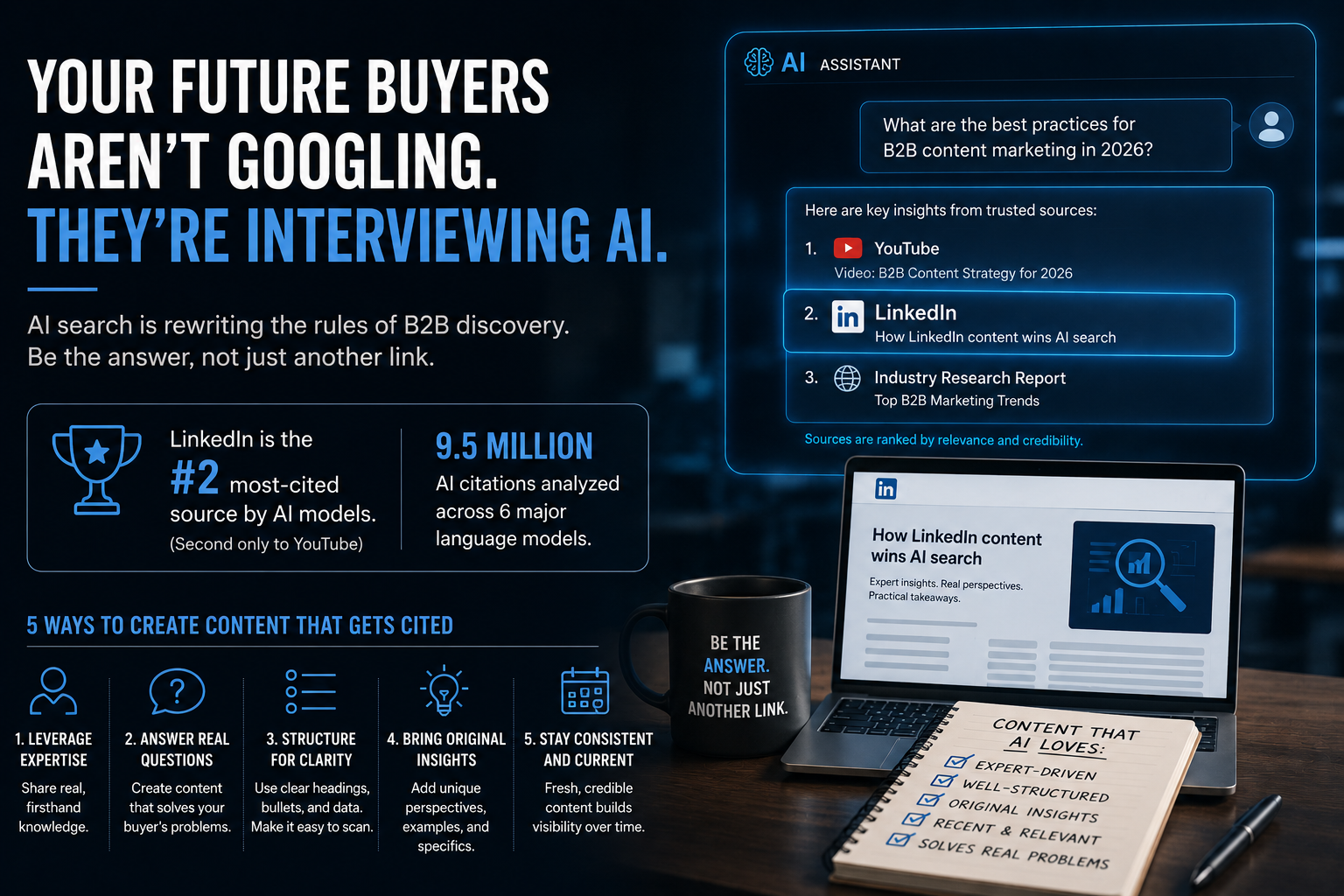
AI Search Is Rewriting the B2B Marketing Playbook
For years, B2B marketers obsessed over rankings.
Page one.
Position zero.
Featured snippets.
Now buyers are skipping the search results entirely and asking AI for answers.
And AI isn't scrolling through ten blue links.
It's deciding who gets quoted.
Which means the game has changed.
The question is no longer:
"Can people find your content?"
It's:
"Will AI trust your content enough to mention it?"
From Keywords to Conversations
Traditional search was built around keywords.
AI search is built around questions.
Instead of searching:
"best CRM software"
Buyers now ask:
"What's the best CRM for a 50-person SaaS company that needs strong reporting but doesn't want enterprise pricing?"
That's a very different game.
The good news?
B2B marketers have something AI loves:
Complex problems.
Detailed expertise.
Real-world experience.
The bad news?
Most B2B content still reads like it was written to impress a search engine from 2018.
What The Research Shows
Recent analysis of millions of AI citations revealed something surprising:
LinkedIn has become one of the most frequently cited sources used by major AI models.
Why?
Because AI systems tend to favor:
Expert-driven content
Real-world insights
Clear explanations
Structured information
Recent and relevant perspectives
In other words:
The content your buyers actually want to read.
What a concept.
Five Ways To Create Content AI Actually Wants To Cite
1. Turn Expertise Into Content
Your best content probably isn't sitting in your marketing folder.
It's sitting inside:
Sales calls
Customer conversations
Product teams
Consultants
Industry specialists
AI rewards firsthand knowledge.
Not recycled thought leadership that sounds like it was generated during a caffeine shortage.
2. Answer Real Buyer Questions
Stop asking:
"What content should we publish?"
Start asking:
"What would my buyer ask ChatGPT at 11:37 PM before presenting to their boss tomorrow?"
The best-performing formats often include:
Buyer's guides
Vendor comparisons
Frameworks
Checklists
Rankings
Decision-making content
Help people solve problems.
AI notices.
3. Make Your Content Easy To Scan
AI reads content a lot like busy executives do.
Fast.
Use:
Clear headings
Bullet points
Short sections
Specific examples
Data and statistics
If your article looks like a wall of text, neither humans nor machines are sticking around.
4. Bring Original Thinking
AI has already seen generic content.
A lot of it.
Probably too much of it.
The content most likely to earn citations includes:
Unique frameworks
Real examples
Contrarian insights
Original research
Practical trade-offs
"Be authentic" is not an insight.
"Here's exactly what worked and what failed" is.
5. Stay Consistent
One great article helps.
A consistent stream of useful content helps a lot more.
AI systems continually evaluate fresh information.
The brands that show up repeatedly become easier to trust.
Consistency compounds.
Just like retirement savings.
Only slightly less exciting.
The New Visibility Question
For years marketers asked:
"How do we rank?"
Today the better question is:
"How do we become the answer?"
Because when buyers start their journey inside AI tools, visibility doesn't come from being found.
It comes from being referenced.
And the brands that master that shift early will have a major advantage while everyone else is still refreshing keyword rankings.
