
Your B2B Tech Marketing Budget Is Massive. So Why Does It Still Look Like Stock Photography?
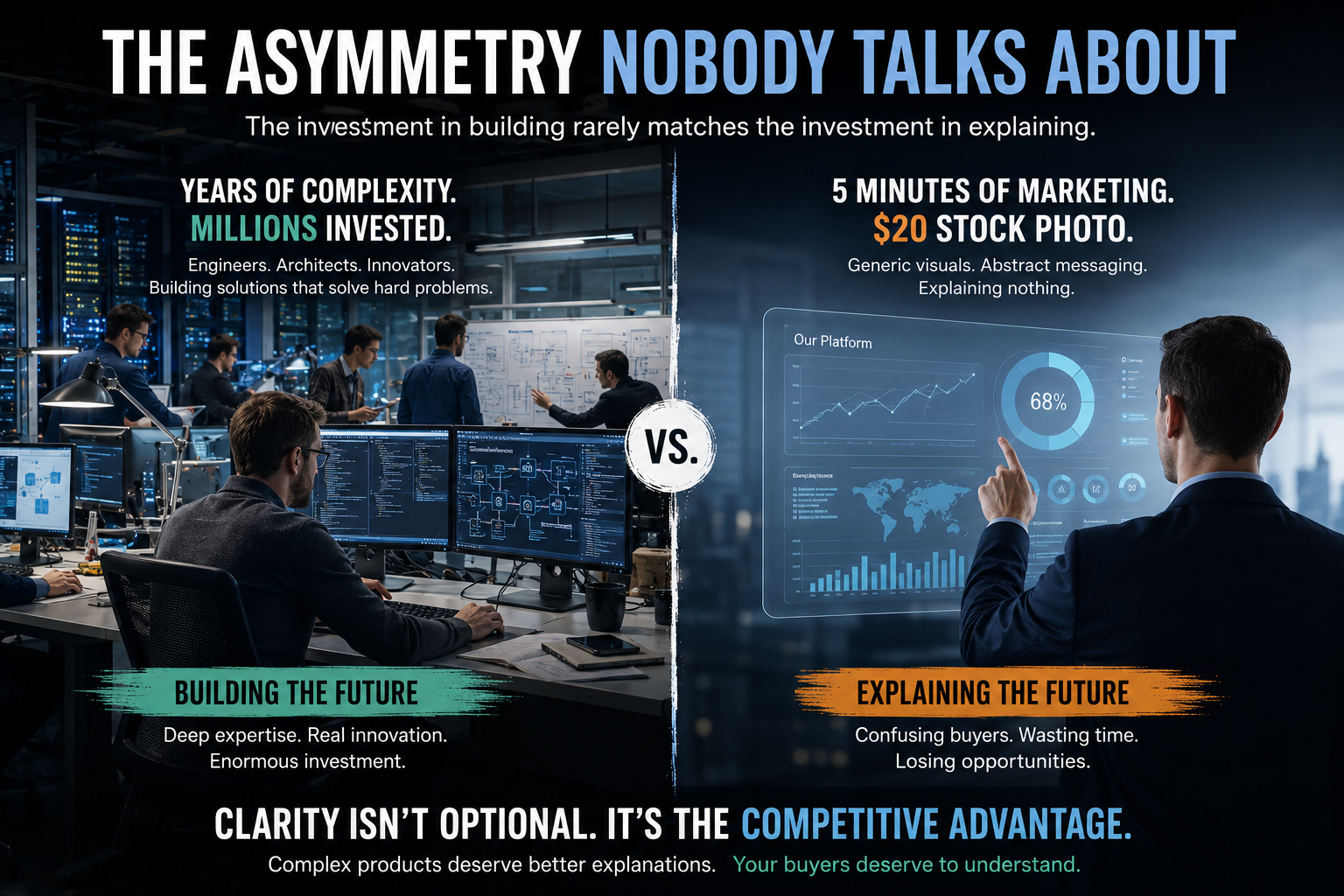
Your B2B Tech Marketing Budget Is Massive. So Why Does It Still Look Like Stock Photography?
Enterprise technology companies spend years building products.
Millions of dollars.
Hundreds of meetings.
Thousands of development hours.
Architects architect.
Developers develop.
Product managers manage products.
Everyone works tirelessly to solve genuinely difficult problems.
Then marketing gets involved.
And suddenly the homepage hero image is a smiling person pointing at a floating blue hologram that appears to have been downloaded from the Internet in 2013.
The website wins a design award.
Prospects still have no idea what the product actually does.
The Most Expensive Gap in B2B Tech Marketing
There is a strange imbalance in enterprise technology.
Companies invest heavily in building complex solutions.
But invest surprisingly little in helping buyers understand them.
The result?
A beautifully engineered product hidden behind generic visuals, vague messaging, and marketing assets that could belong to almost any company in the industry.
Stock photos.
Blue gradients.
Abstract diagrams.
Random geometric shapes attempting to represent "innovation."
None of these explain anything.
And explanation is the entire job.
The Problem Isn't Budget
If this were a budget issue, it would be easy to solve.
But some of the biggest offenders are companies with enormous marketing budgets.
The issue isn't money.
It isn't talent.
Most enterprise marketing leaders already know something is missing.
The challenge is that explaining complex technology visually is genuinely difficult.
Much harder than creating another white paper.
Much harder than producing another product video.
Much harder than filling another website template.
Most organizations simply haven't built a repeatable process for translating complexity into clarity.
Why Buyers Leave Before They Understand
Enterprise solutions rarely fail because buyers aren't smart enough.
They fail because buyers never get the chance to become informed.
A prospect lands on a website.
Ten seconds later they're gone.
Not because the solution lacks value.
Because nothing helped them understand the value quickly.
The visual language didn't invite them in.
It didn't show how the solution works.
It didn't connect features to outcomes.
Instead, buyers received another dose of "digital transformation" imagery and moved on with their lives.
Why Most Marketing Content Falls Apart
Most content agencies specialize in formats.
They make videos.
They design infographics.
They create animations.
But very few start with the harder question:
How should a buyer understand this idea?
That's a completely different skill.
Before any production happens, someone has to understand the technology deeply enough to uncover the story inside it.
The visual narrative.
The mental shortcut.
The explanation that turns complexity into clarity.
Without that foundation, production simply becomes decoration.
The Great B2B Handoff Problem
Here's where many enterprise marketing programs quietly fail.
One team develops the strategy.
Another writes the brief.
A third creates the visuals.
A fourth produces the final asset.
By the end of the process, the original insight has been translated so many times that it barely resembles the original idea.
The finished content looks polished.
It just doesn't explain anything.
It's like playing corporate telephone with a cybersecurity platform.
What Actually Works
The companies that consistently explain complex products well follow a different model.
The thinking and the execution stay connected.
The same people who develop the visual narrative remain involved throughout production.
From the first sketch.
To the website.
To the sales deck.
To the event booth.
To the customer presentation.
Because when the explanation survives every stage, buyers finally understand what they're looking at.
And when buyers understand, sales conversations become easier.
Funny how that works.
Explanation Is the Competitive Advantage
For years, enterprise technology marketing has relied on substitutes:
Stock photography
Generic animations
Template-driven design
Dense blocks of text
They look professional.
They ship on time.
Legal approves them.
Everyone moves on.
Except the buyer.
The buyer is still confused.
And confusion is expensive.
Longer sales cycles.
More objections.
More skepticism.
More dependence on sales teams to explain what marketing should have explained already.
The Companies Winning This Game
The organizations that break through don't necessarily create more content.
They create clearer content.
They treat explanation as a strategic capability rather than a design exercise.
Because the reality is simple:
If your product took five years to build, it probably deserves more than a stock photo and a headline about innovation.
The companies building technology worth understanding deserve marketing that actually helps people understand it.
That's where the real competitive advantage lives.
