
B2B Marketing Isn't a Lottery: Stop Throwing Darts in the Dark
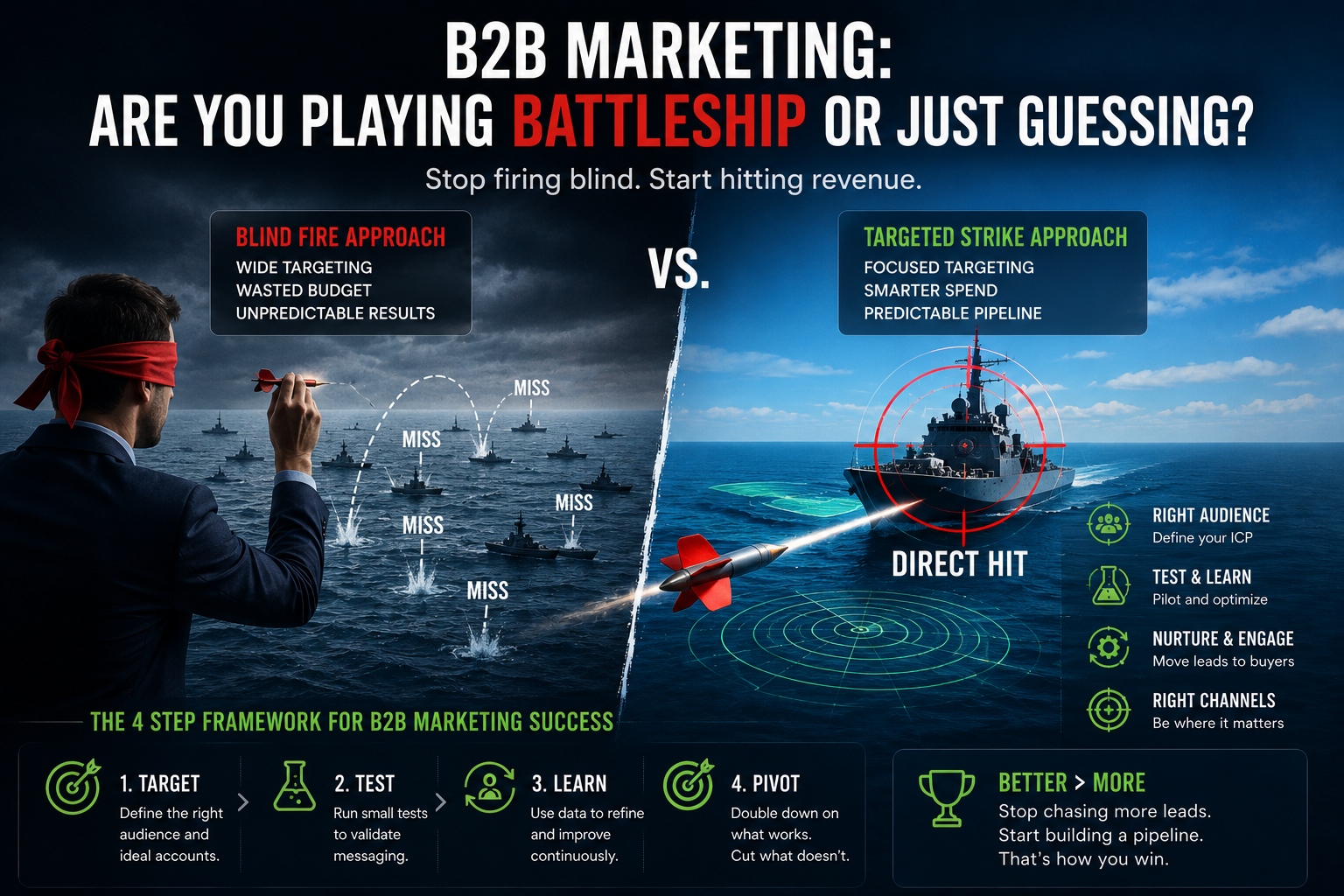
A surprising number of B2B marketing strategies have one thing in common:
They look suspiciously like hope.
Hope that a bigger email list will generate more leads.
Hope that more ad spend will somehow solve poor targeting.
Hope that posting more content will magically create pipeline.
It's the marketing equivalent of standing in a dark room throwing darts and celebrating when one accidentally hits the board.
Unfortunately, enterprise buyers don't work that way.
In B2B, random acts of marketing rarely produce predictable revenue.
The companies winning today aren't casting wider nets.
They're aiming more carefully.
Every Miss Is Trying to Tell You Something
Most marketers see disappointing campaign results and immediately label them failures.
Smart marketers see feedback.
A low click-through rate isn't bad luck.
It's your audience telling you the message missed the mark.
Poor conversion rates aren't always a landing page problem.
They often signal you're talking to the wrong people altogether.
Every metric is a clue.
Every campaign is a test.
Every result is data.
The goal isn't perfection.
The goal is getting slightly smarter every time you launch something.
The Four-Step Formula for Better B2B Marketing
1. Know Exactly Who You're Trying to Reach
You can't hit a target you haven't defined.
Before launching campaigns, get crystal clear on your Ideal Customer Profile (ICP).
Who has the budget?
Who has the problem?
Who is actively looking for a solution?
If your audience definition includes "basically anyone," you've already lost.
2. Test Small Before Spending Big
Too many companies launch massive campaigns based on assumptions.
Instead, run controlled experiments.
Test messages.
Test audiences.
Test offers.
Let data earn the right to receive more budget.
Your CFO will appreciate it.
3. Build a Nurture System, Not a Lead Graveyard
Generating a lead is the easy part.
Converting one is where the real work begins.
Most buyers don't wake up, see an ad, and immediately request a contract.
They research.
They compare.
They disappear for three weeks.
Then they come back.
A strong nurture strategy keeps the conversation alive through content, retargeting, sales enablement, and consistent value.
4. Stop Trying to Be Everywhere
Being omnichannel doesn't mean opening accounts on every platform known to humanity.
It means showing up where your buyers actually spend time.
If LinkedIn and email drive results, double down.
If another channel consistently produces nothing except confusion and dashboard screenshots, it might be time to let it go.
Bigger Isn't Better
One of the most expensive myths in B2B marketing is that growth comes from doing more.
More leads.
More traffic.
More campaigns.
More spend.
In reality, better beats bigger almost every time.
Better targeting.
Better messaging.
Better positioning.
Better follow-up.
The companies generating predictable growth aren't chasing volume.
They're improving precision.
The Real Competitive Advantage
Here's the uncomfortable truth:
Many of your competitors are still guessing.
They're running campaigns because everyone else is.
They're following playbooks they inherited years ago.
They're optimizing activity instead of outcomes.
That creates an opportunity.
The companies willing to focus, test, learn, and adapt gain an enormous advantage.
Not because they're spending more.
Because they're wasting less.
Final Thought
The future of B2B marketing doesn't belong to the loudest companies.
It belongs to the most precise ones.
The goal isn't to fire more shots.
The goal is to know exactly where you're aiming before you pull the trigger.
Because in B2B, success isn't about getting lucky.
It's about getting smarter.
