
The LinkedIn Revenue Engine Most B2B Companies Forget to Build
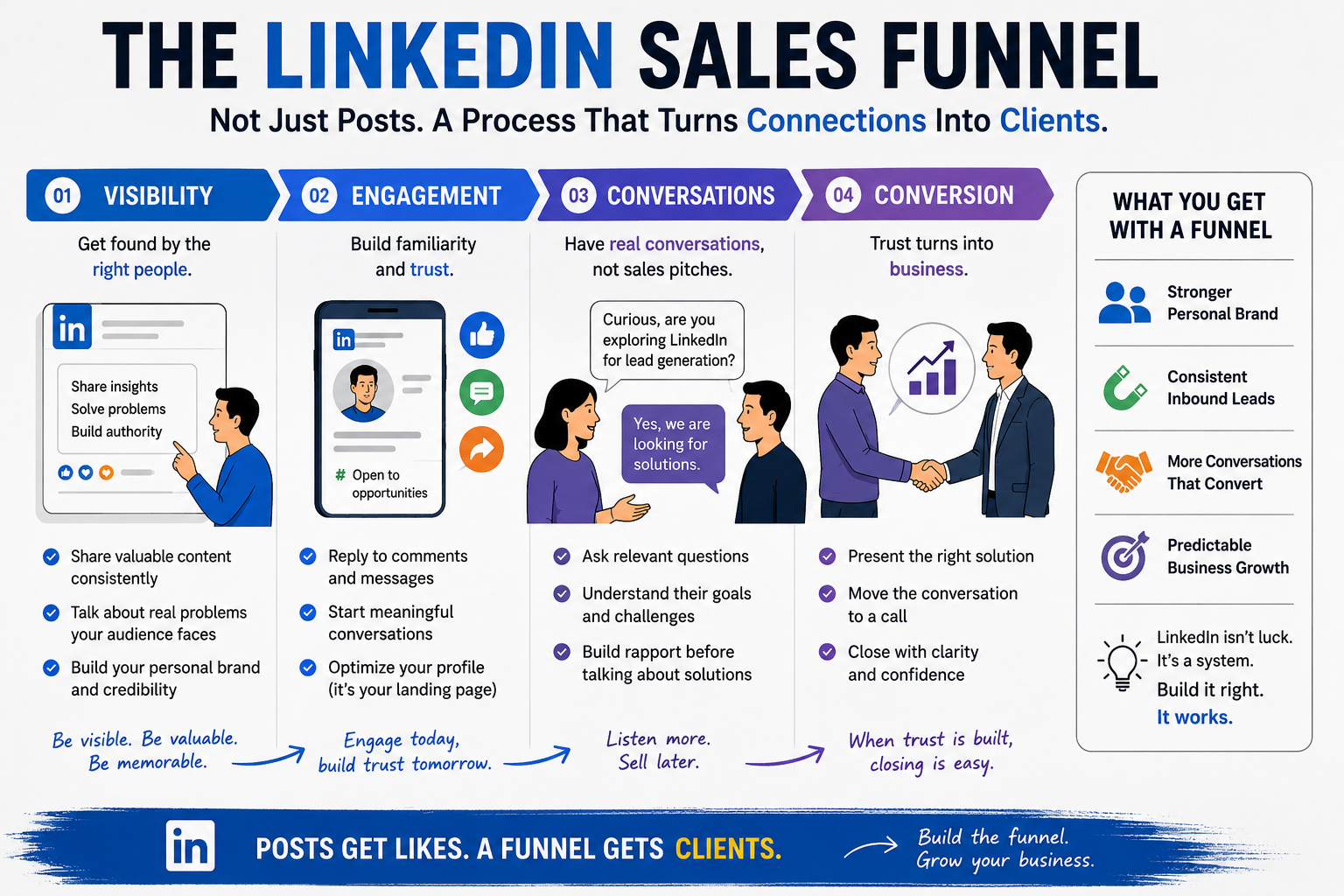
A lot of B2B companies say the same thing:
“LinkedIn doesn’t work for us.”
Usually, that’s not true.
What’s actually happening is much simpler: there’s no funnel. Just posting, hoping, and occasionally sending a message that starts with “Hi, we offer services…”
That’s not a strategy. That’s digital cold-calling in nicer fonts.
When companies treat LinkedIn like a real sales funnel instead of a random posting platform, the results look very different.
Here’s the simple framework.
What a LinkedIn Sales Funnel Actually Looks Like
A LinkedIn funnel is just the path someone takes from not knowing you exist to eventually becoming a client.
It usually looks like this:
Stranger → Connection → Conversation → Client
The mistake most companies make is skipping everything in the middle and jumping straight to the pitch.
Imagine meeting someone at an event and opening with:
“Hi, nice to meet you. Would you like to buy my services?”
That’s essentially what many LinkedIn inboxes look like.
Stage 1: Visibility (Where Most Companies Trip)
You can’t generate leads if the right people don’t even know you exist.
Yet many companies post content that reads like a brochure:
“We provide XYZ services. Contact us today.”
That approach worked about ten years ago. Today it mostly gets ignored.
People use LinkedIn to learn, evaluate, and observe before they ever talk to someone.
The content that actually builds visibility tends to focus on:
Real insights from the industry
Common problems buyers face
Perspectives from founders or operators
This is where personal perspective matters. It creates familiarity much faster than corporate messaging.
Stage 2: Engagement (Where Trust Starts)
Once people start seeing your content consistently, something important happens: they begin to recognize you.
Recognition leads to interaction.
But this stage often gets ignored. Companies post content and then disappear.
No replies to comments.
No conversations started.
Profiles that still read like résumés.
Your LinkedIn profile is not a résumé. It’s your landing page.
If someone visits your profile and can’t immediately understand:
Who you help
What you solve
Why it matters
The journey stops right there.
Stage 3: Conversations (Not Instant Pitches)
This is where things go wrong for many companies.
The moment someone accepts a connection request, the message appears:
“Hi, we offer services. Are you interested?”
That’s not outreach. That’s a polite way of saying, “Please ignore this message.”
Conversations should feel like conversations.
Instead of pitching immediately, start by understanding where the person is.
For example:
“Curious — are you currently exploring LinkedIn for lead generation?”
Now you’re starting a discussion rather than delivering a sales script.
That small shift dramatically improves response rates.
Stage 4: Conversion (Where the Work Pays Off)
If the earlier stages are done properly, selling becomes much easier.
By this point, the prospect has:
Seen your content
Understood your expertise
Become comfortable interacting with you
Now the conversation can naturally move toward a call, a proposal, or a solution.
There’s no need for aggressive selling because the trust has already been built.
Why Many B2B Companies Struggle on LinkedIn
From what we often see, the same patterns appear again and again:
No clear content strategy
Inconsistent posting
Weak messaging
No defined funnel
Trying to sell far too early
LinkedIn rarely fails because the platform doesn’t work.
It fails because the process around it is missing.
What Changes When a System Is in Place
When LinkedIn is treated like a structured funnel instead of a random activity feed, several things happen:
Content builds authority.
Profiles convert curiosity into interest.
Conversations turn into opportunities.
Over time, the platform becomes:
A powerful personal brand channel
A consistent source of inbound leads
A trust engine for the business
A Final Thought
If your LinkedIn activity feels random, inconsistent, or unproductive, the answer usually isn’t “post more.”
It’s building a better system.
Because when LinkedIn is used strategically, it stops being just another social network and starts functioning like a long-term revenue engine.
