
From Keywords to Customer Prompts: The New Reality of B2B Search
Dear B2B marketers,
You’ve probably heard the phrase by now: “Prompts are the new keywords.”
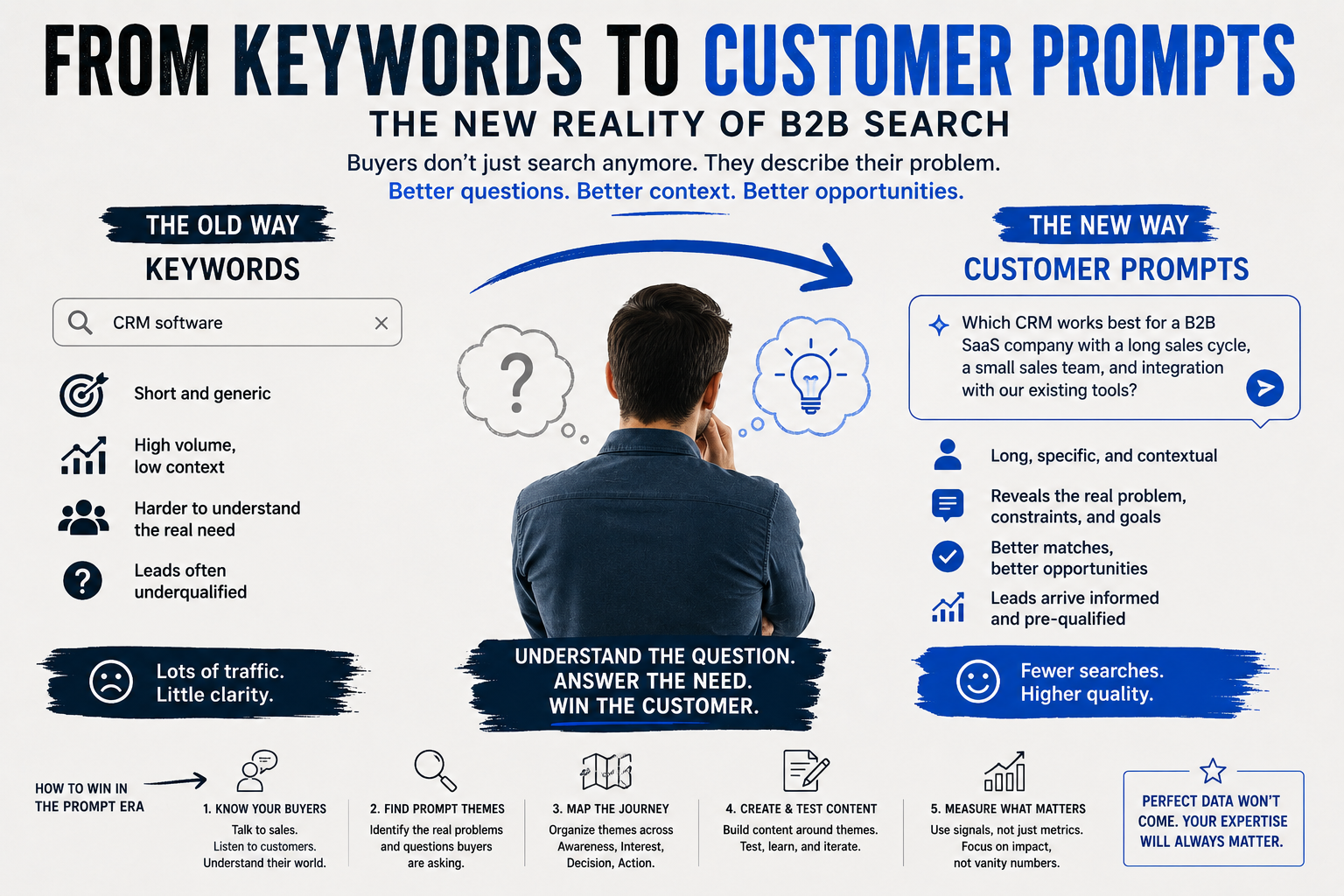
That statement isn’t wrong. But it’s also incomplete. Because this shift doesn’t just change SEO tactics. It changes how we understand buyers, structure content, and measure success.
Traditional keyword search is evolving into something closer to a conversation. Instead of typing two-word queries, buyers now describe their situation in detail—especially when they interact with AI-powered search tools.
For B2B marketers, this change is actually good news.
When someone writes a detailed prompt, they reveal much more than a keyword ever could. They describe their problem, their constraints, and their context. Instead of trying to match vague search terms, your content now has the chance to answer a very specific business need.
B2B environments are naturally complex. Prompts reflect that complexity.
If you’ve ever received a lead who discovered you through an AI assistant, you may have noticed something interesting: those leads often arrive well informed. They’ve already discussed their situation with the AI, explored possible solutions, and clarified their requirements. By the time they reach your company, they often know exactly what they want.
In other words, prompts don’t simplify the buyer journey. They compress it.
But this new reality also creates challenges.
First, prompts are highly individualized. People rarely phrase their questions in identical ways. Unlike traditional keywords that appeared thousands of times in analytics tools, prompts are often unique.
That means marketers can’t chase individual queries anymore. Instead, we need to identify broader prompt themes—the underlying problems and motivations that drive these conversations.
Second, measuring prompt visibility is still difficult. The first generation of AI search visibility tools is emerging, but the data is far less stable than traditional keyword rankings.
Ironically, that might not be a bad thing.
Keyword metrics always looked precise, but in many B2B niches they pushed marketers toward high-volume generic terms that rarely translated into pipeline.
The new environment forces marketers to rely less on dashboards and more on actual market understanding.
This means spending more time talking with sales teams, listening to customers, and identifying the real problems buyers are trying to solve.
If we combine that human understanding with signals like long-tail queries and prompt patterns, we can begin mapping the “prompt landscape.”
Will it ever be as tidy as a keyword ranking report? Probably not.
But it will likely be closer to reality.
A practical way to start is simple: identify the main prompt themes in your market and map them across the buyer journey—Awareness, Interest, Decision, and Action.
Then build content around those themes.
Test, learn, and iterate.
Perfect data will never arrive. And waiting for it only means one thing: when buyers ask their AI assistant a question, someone else’s content will provide the answer.
The absence of perfect metrics is not a reason to pause.
It’s a reason to trust your expertise.
