
Why “B2B Ecommerce” Is Harder Than Most Platforms Admit
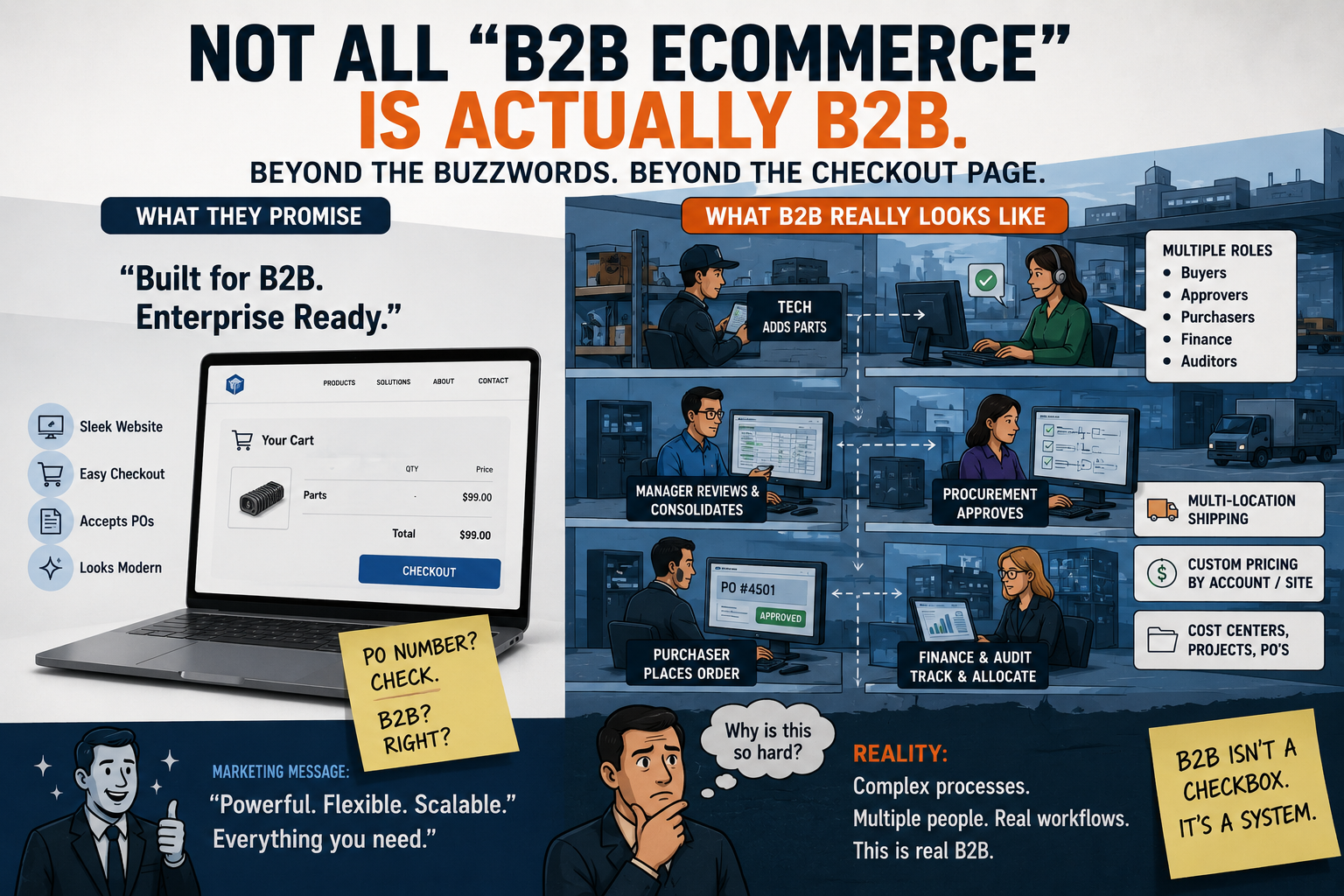
There’s a quiet truth in ecommerce that doesn’t make it into many marketing brochures:
A lot of platforms claiming to support B2B… don’t really support B2B.
And if you believe the marketing too quickly, that misunderstanding can turn into a very expensive lesson.
I was speaking with someone from a parts distribution company recently. Most of their online sales were to consumers and small independent repair shops. Naturally, they assumed expanding into larger business buyers would be straightforward.
Their question was simple:
“If we’re already selling online, how hard can it be to sell to businesses too?”
The honest answer? Much harder than it looks.
Start With Account Structure
One of the easiest ways to spot whether a platform truly supports B2B is to look at how it handles accounts.
In direct-to-consumer ecommerce, the model is simple. One customer, one account, one person browsing, buying, and paying.
Done.
B2B buying is rarely that tidy.
Imagine a maintenance company ordering parts for multiple buildings. A technician adds items to a cart for a repair. That cart might then move to a department manager who consolidates multiple technicians’ requests. Procurement may step in afterward to approve and place the order using a purchase order or corporate card.
Depending on the organization, there may be several approval layers involved before the order is finalized. Later, finance or audit teams might review purchases and assign costs to specific projects or departments.
This isn’t some extreme edge case. It’s a fairly typical B2B purchasing process.
Many platforms claim B2B capabilities simply because they allow purchase orders as a payment method. That’s not B2B functionality. That’s just a checkout option.
A real B2B system supports multiple roles within a customer account, such as buyers, approvers, and purchasers, with workflows that mirror how companies actually operate.
If the platform can’t do that, it’s basically a consumer storefront with a purchase order field added on.
Complexity Doesn’t Stop There
Account roles are just the beginning.
Once companies begin operating at scale, the requirements expand quickly.
Orders may need to ship to multiple locations. Line items might need to be assigned to different cost centers or departments. One order could involve several purchase orders depending on how the customer tracks expenses internally.
Pricing introduces another layer of complexity.
Many B2B companies negotiate custom pricing with individual clients. One customer may have different pricing tiers than another. Sometimes even different locations within the same company operate under separate pricing structures.
Can the platform support parent accounts with multiple sub-accounts, each with unique roles and pricing models?
If the answer is “not really,” then the platform probably wasn’t designed for true B2B commerce.
Why So Many Platforms Claim B2B Support
B2B ecommerce represents one of the biggest growth opportunities in digital commerce today.
There are still thousands of companies whose ordering process is essentially “call us.”
Naturally, ecommerce vendors see that opportunity and position themselves as the solution.
The problem is that companies new to B2B ecommerce often don’t yet know what they’ll need.
At launch, everything might appear to work fine. Orders come in, customers are happy, and the website technically functions.
But issues begin to surface later.
The moment a customer needs complex pricing. Or approval workflows. Or multi-location shipping. Suddenly the platform starts requiring workarounds, plugins, or manual processes.
That’s when companies discover the real cost of choosing the wrong system.
Not the initial investment.
The painful re-platforming project that comes later.
What Buyers Should Actually Evaluate
When assessing a B2B ecommerce platform, it’s important to look beyond the marketing claims.
Ask specific questions about how the system works.
How many user roles can exist within a customer account?
Can a single company operate multiple sub-accounts?
Can pricing vary by customer, location, or business unit?
Can line items be assigned to different cost centers within the same order?
If the answers feel vague, or depend heavily on third-party apps, that should raise a red flag.
A mature B2B platform should support these capabilities out of the box. Even if you don’t need every feature immediately, they should be available as your business grows.
It’s far easier to grow into a system built for complexity than to outgrow one designed primarily for consumer sales.
Doing proper due diligence upfront may not feel exciting.
But it will save a lot of pain later.
