
Why B2B Tech Spends Millions Building Products… and $12 Explaining Them
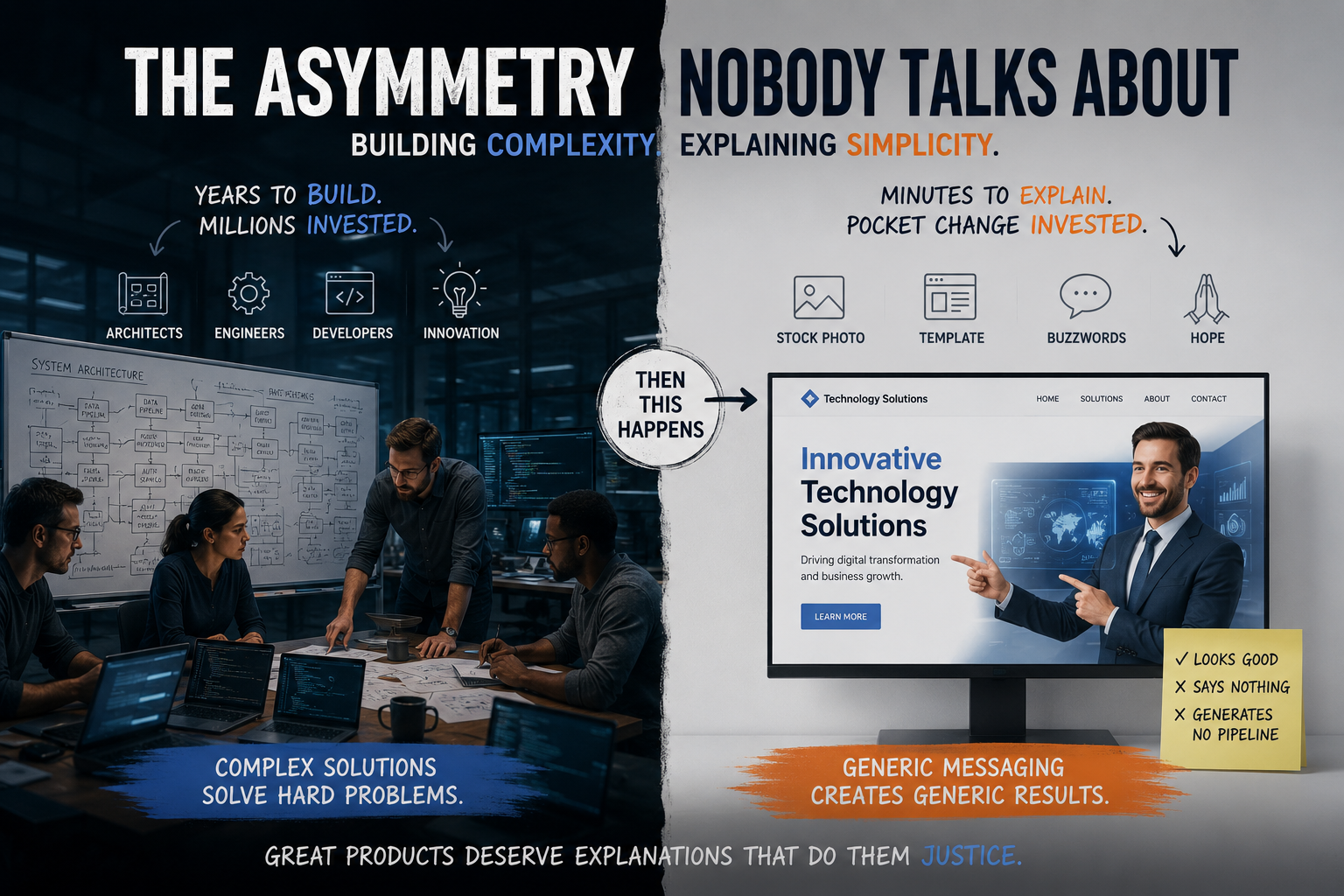
B2B tech companies are very good at building complicated things.
They’ll spend years developing a platform.
Millions of dollars on engineering.
Entire teams of product managers, architects, and specialists solving extremely difficult problems.
Then comes the moment when they need to explain what they built.
And somehow the marketing solution becomes:
A stock photo of a businessman pointing at a glowing dashboard.
The website looks beautiful.
It wins a design award.
And the pipeline remains… suspiciously quiet.
The Hidden Imbalance in B2B Tech Marketing
There’s an imbalance in B2B technology marketing that most companies don’t even notice anymore.
The investment in building the product is massive.
The investment in explaining the product is often… minimal.
Even worse, the tools most companies rely on aren’t just ineffective — they’re the wrong tools entirely.
Stock photos.
Template websites.
Generic animations.
They may look professional, but they communicate almost nothing.
They don’t explain the mechanism.
They don’t highlight differentiation.
They don’t make complex ideas understandable.
And in B2B, understanding is everything.
Why Complex Products Lose Buyers Early
Enterprise products rarely fail because buyers are incapable of understanding them.
They fail because buyers never get the chance.
In the first few seconds of visiting a website or seeing marketing material, buyers decide whether to keep paying attention.
If nothing in those first moments helps them understand:
what the product does
how it works
why it matters
they leave.
Not because they’re unsophisticated.
Because nothing invited them to stay.
Explaining Complexity Starts Before Design
When explaining complex technology, the real work starts long before design.
It starts with thinking.
Before any visuals are produced, the process should begin with something much simpler:
A blank page.
And a pencil.
This is where the real work happens — mapping out how a complicated idea can be explained clearly and quickly.
Storyboarding the mechanism.
Breaking complexity into a structure that a buyer can grasp within seconds.
Explaining enterprise products requires the same rigor used to build them.
Because you cannot explain a sophisticated system with clip art and a gradient background.
Where Explanation Matters Most
This kind of visual thinking impacts nearly every part of a B2B marketing organization.
Product Marketing
Solution explainer videos
Interactive product tours
ROI visualizations
Platform overview animations
Technical differentiation frameworks
Content Marketing and Thought Leadership
Visual whitepapers
Research report design
Data visualizations
Infographic series
Narrative-driven visual storytelling
Brand and Corporate Communications
Visual identity systems
Brand narrative frameworks
Executive presentations
Annual report storytelling
Sales Enablement
Sales deck architecture
Proposal visuals
Competitive battlecards
Demo environment graphics
Event and Field Marketing
Keynote presentations
Trade show visual systems
Session storytelling
Experiential content environments
Every one of these moments determines whether a buyer understands the product… or doesn’t.
And when the explanation fails, the product rarely gets a second chance.
The Real Opportunity in B2B Marketing
Many technology companies have built products that genuinely deserve attention.
They solve complex problems.
They introduce real innovation.
But innovation only matters if buyers can understand it.
And that’s the real asymmetry in B2B marketing today.
Companies spend enormous resources building sophisticated products.
Yet far fewer resources explaining them clearly.
The companies that fix this imbalance don’t just look better.
They become dramatically easier to understand.
And in B2B markets, the companies that are easiest to understand are often the ones that win.
