
B2B Influencer Marketing Isn’t About Influencers Anymore. It’s About Trust.
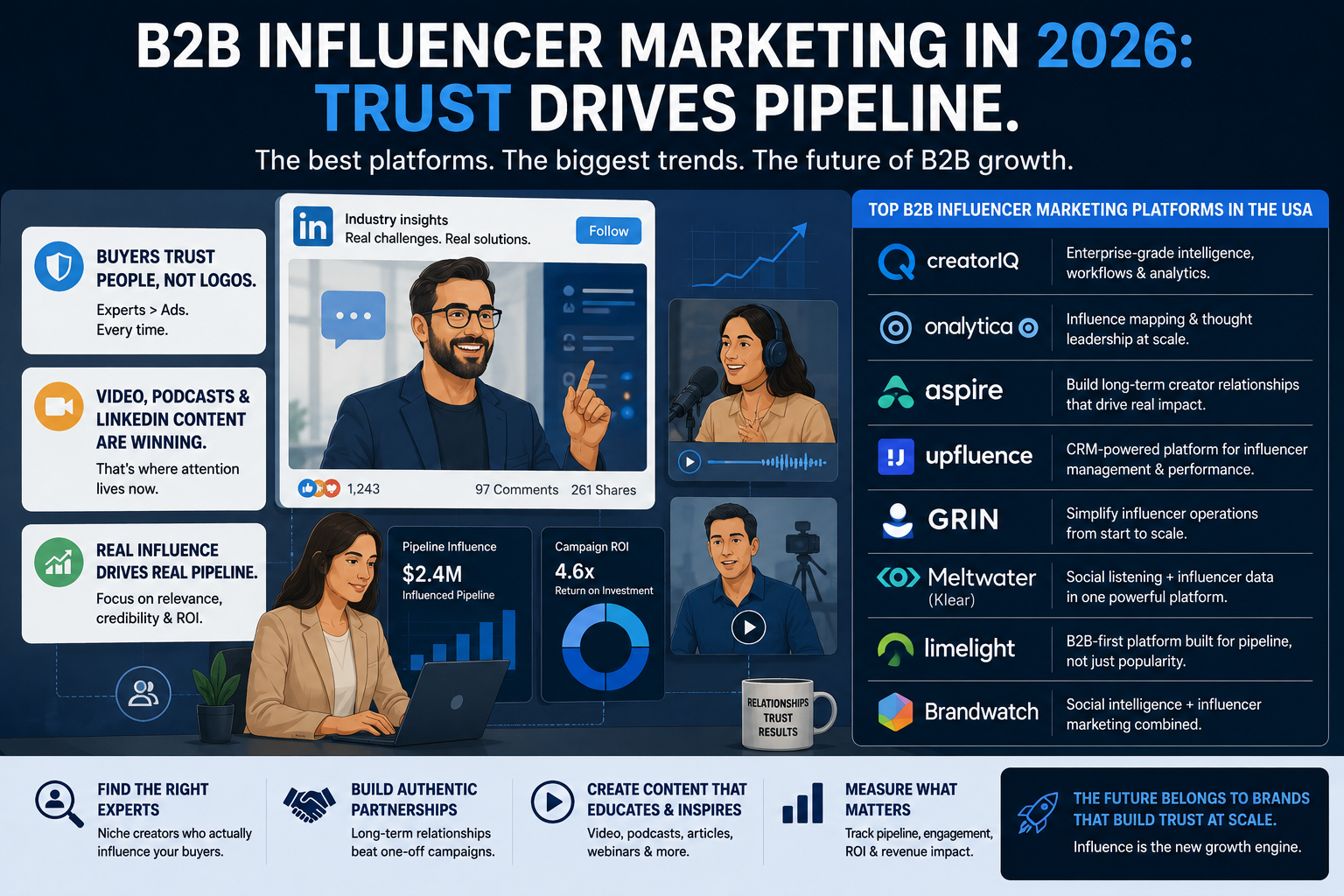
For years, B2B companies treated influencer marketing like a weird cousin of “real marketing.”
Something for skincare brands.
Fitness creators.
People filming protein powder reviews in parking lots.
Meanwhile, enterprise tech companies stayed loyal to:
cold emails nobody reads
webinars with 14 attendees
LinkedIn ads targeting “VPs who like innovation”
But in 2026?
The game changed.
Because buyers stopped trusting logos…
and started trusting people.
That shift is quietly rewriting B2B marketing.
The Big Shift Nobody Can Ignore
Modern B2B buyers don’t wake up thinking:
“Can’t wait to read another corporate whitepaper today.”
Instead, they:
watch LinkedIn creators
listen to niche podcasts
follow industry operators
binge YouTube explainers
trust founders who share real insights
And by the time they finally talk to sales?
They already have opinions.
Already have preferences.
Already have a shortlist.
Usually influenced by creators long before marketing automation even noticed they existed.
Why B2B Influencer Marketing Is Exploding
Traditional B2B tactics still matter.
But let’s be honest:
paid ads are getting more expensive
outbound response rates are falling off a cliff
buyers research independently for months
The old “book a demo immediately” funnel is looking a little tired.
Today, trust is the real acquisition channel.
And trust travels faster through:
experts
operators
consultants
educators
founders
technical creators
Not corporate slogans.
A cybersecurity engineer explaining threat detection on LinkedIn?
More persuasive than most banner ads.
A SaaS operator reviewing workflow tools on YouTube?
Probably generating better leads than your gated ebook.
The modern buyer wants:
“Show me someone who actually understands my problem.”
Not:
“Download our 37-page PDF called The Future of Digital Synergy.”
The Problem With Most Influencer Platforms
Most influencer tools were originally built for:
fashion brands
beauty creators
lifestyle campaigns
Which is why some B2B marketers open these platforms and immediately feel like:
“I’m trying to buy enterprise pipeline inside Instagram prom season.”
B2B influencer marketing works differently.
Follower count matters less.
Audience quality matters more.
A niche AI consultant with 12,000 trusted followers can outperform a “business influencer” with 500,000 generic ones.
Because in B2B:
relevance beats reach almost every time.
What Good B2B Influencer Platforms Actually Do
The best B2B influencer platforms help brands:
discover credible niche experts
analyze audience quality
track pipeline influence
manage creator relationships
measure ROI properly
support LinkedIn-first campaigns
And importantly…
They help companies stop confusing:
“viral engagement”
with
“actual commercial influence.”
Two very different things.
The Platforms Leading the Market
Several platforms are becoming major players in B2B influencer marketing:
CreatorIQ
Popular with enterprise brands managing large-scale influencer operations.
Strong for:
analytics
workflow management
creator intelligence
enterprise reporting
Basically:
“serious infrastructure for serious marketing teams.”
Onalytica
Built specifically around B2B influence and thought leadership.
Excellent for:
enterprise tech
cybersecurity
finance
analyst relations
niche industry influence mapping
Less “creator economy.”
More “who actually influences buying committees.”
Aspire
Great for long-term creator partnerships instead of one-off sponsored posts.
Perfect for brands trying to build:
recurring creator ecosystems
ambassador programs
ongoing trust
Because one sponsored post rarely changes a pipeline.
Repeated trust usually does.
Upfluence
Strong operational workflow platform with integrated CRM functionality.
Good for:
startups
scaling SaaS brands
performance-focused campaigns
Also helps marketers avoid managing influencer campaigns across:
17 spreadsheets,
9 Slack threads,
and one panicked Google Doc.
Meltwater + Klear
Strong mix of:
influencer tracking
social listening
media monitoring
sentiment analysis
Especially useful for PR-heavy B2B organizations.
Limelight
One of the newer platforms focused specifically on B2B creator relationships and pipeline impact.
Less “influencer culture.”
More “industry credibility.”
Which honestly feels refreshing.
Why LinkedIn Is Now the Main Stage
LinkedIn quietly became the biggest B2B creator platform on Earth.
And most companies still underestimate it.
Founders, operators, consultants, marketers, and technical experts are building massive trust-based audiences there every day.
The platform now rewards:
educational content
video
thought leadership
personal storytelling
creator-led insights
Which means B2B companies no longer need to rely entirely on corporate pages that average:
3 likes,
1 accidental click,
and one employee forced to repost it internally.
Instead, brands are partnering directly with trusted voices.
That’s where attention lives now.
Video Is Becoming the New Default
B2B buyers increasingly consume information like consumers:
faster
visually
socially
Which means:
LinkedIn video
podcasts
YouTube explainers
webinars
live sessions
creator-led education
…are becoming core influence channels.
Static PDF-heavy marketing isn’t dead.
But it’s definitely sweating nervously.
AI Is Changing Everything Too
Modern influencer platforms now use AI for:
creator discovery
fraud detection
audience analysis
campaign optimization
attribution modeling
Because manually tracking creator ecosystems at scale is basically impossible now.
The future of B2B influence will combine:
🤖 AI-driven discovery
🧠 human trust
🎥 creator-led education
📈 pipeline-focused measurement
Not vanity metrics.
Not “brand vibes.”
Real business outcomes.
The Biggest Mistake B2B Brands Still Make
Most companies still optimize for:
reach.
The smarter companies optimize for:
credibility.
Those are not the same thing.
The future winners in B2B influencer marketing won’t necessarily have the loudest creators.
They’ll have the most trusted ones.
Because business buyers don’t need more content.
They need more confidence.
