
Why Enterprise Tech Marketing Still Looks Like a Stock Photo Convention
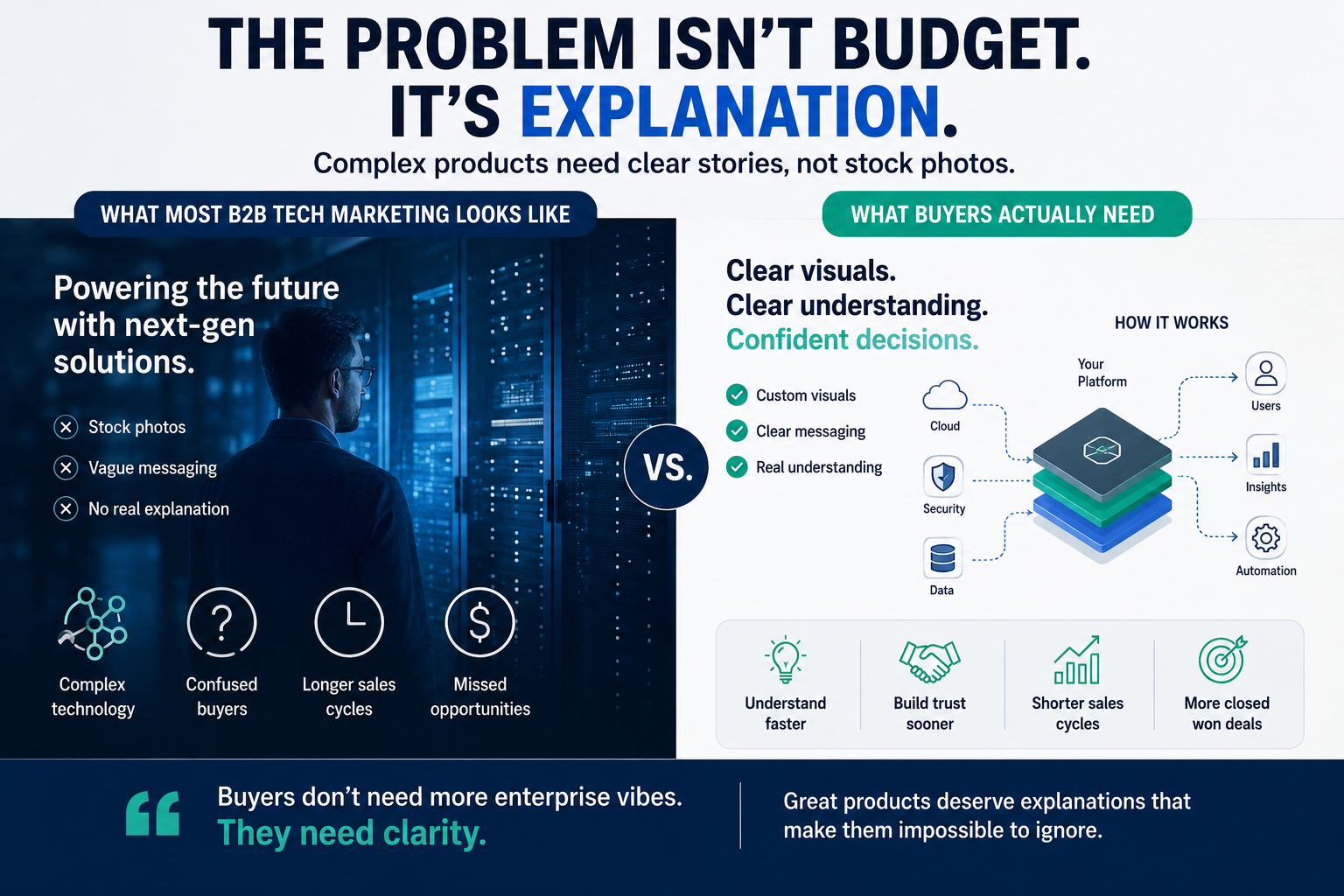
Most enterprise tech companies spend years building brilliant products…
…and about 14 minutes figuring out how to explain them.
That’s the strange little imbalance nobody in B2B marketing talks about enough.
A company will invest millions into engineering:
complex infrastructure platforms
cybersecurity ecosystems
AI-powered solutions
enterprise-grade workflows
Then launch the website with:
a glowing blue gradient
a guy pointing at a floating dashboard
and a headline that says “Driving Digital Transformation at Scale”
Groundbreaking stuff. Truly. 👏
The problem isn’t budget.
Some of the biggest offenders are massively funded enterprise brands with huge marketing teams and polished campaigns.
The problem is simpler:
Most B2B tech marketing looks professional…
but explains absolutely nothing.
And buyers notice.
The Real Problem Isn’t Design. It’s Explanation.
Most enterprise products are complicated.
Not “confusing because the website is messy” complicated.
Actually complicated.
Which means buyers need help understanding:
what the product does
why it matters
how it fits their world
and why they should care before their coffee gets cold
But instead of explaining the product clearly, many brands default to:
stock photos of people smiling at laptops
abstract diagrams with arrows everywhere
animations that look expensive but say very little
The result?
The website wins a design award.
The sales team still has to explain everything manually on every call.
The Hidden Cost of “Looks Good”
When buyers don’t immediately understand your product:
sales cycles get longer
procurement gets more skeptical
demos become harder
sales teams rely entirely on relationships
and marketing becomes “that thing that makes PDFs”
The content isn’t carrying the sale.
It’s decorating it.
That’s a very expensive difference.
Why Most B2B Visual Content Fails
Most agencies are production shops.
They know how to:
make videos
design slides
animate graphics
build websites
But very few know how to take a genuinely technical idea and turn it into something buyers instantly understand.
That work happens before design.
It starts with:
understanding the technology deeply
identifying the buyer’s actual confusion
simplifying complexity without dumbing it down
building a visual story around the idea
That’s the hard part.
And it’s usually skipped.
Instead, companies hand off a brief like:
“Can you make this look more enterprise-y?”
Which is how we end up with another cyber-security landing page featuring:
blue hexagons
glowing particles
and a man standing confidently near servers he definitely does not understand.
The Handoff Problem Nobody Talks About
Another issue:
The people doing the strategy are often completely separated from the people creating the visuals.
So the original thinking gets diluted at every stage.
The strategist explains the concept.
The creative team gets a summary.
Production gets another summary.
Then somehow the final output becomes:
“Future-proof innovation for modern businesses.”
Translation:
Nobody knows what this thing does anymore.
What Actually Works
The best B2B marketing programs treat explanation like product design.
The thinking and the execution stay connected.
The same people who understand the product deeply shape:
the visuals
the narrative
the decks
the demos
the event experience
the customer-facing content
When that continuity exists:
messaging gets clearer
buyers understand faster
sales conversations improve
and marketing starts doing actual commercial work
Not just aesthetic work.
Buyers Don’t Need More “Enterprise Vibes”
They need clarity.
Because no CTO has ever said:
“Wow. Those stock images really helped me understand the architecture.”
In complex B2B markets, explanation is the competitive advantage.
And the companies that solve that problem first usually look smarter…
even before the product conversation starts.
