
The Shortlist You’re Probably Not On (And Why It Controls Your B2B Pipeline)
Hello and welcome,
If you are reading this, congratulations — you are officially part of my very first LinkedIn newsletter. No pressure on me at all.
Let’s start with something every B2B marketer cares about: pipeline. More specifically, the uncomfortable truth about when your pipeline is actually decided.
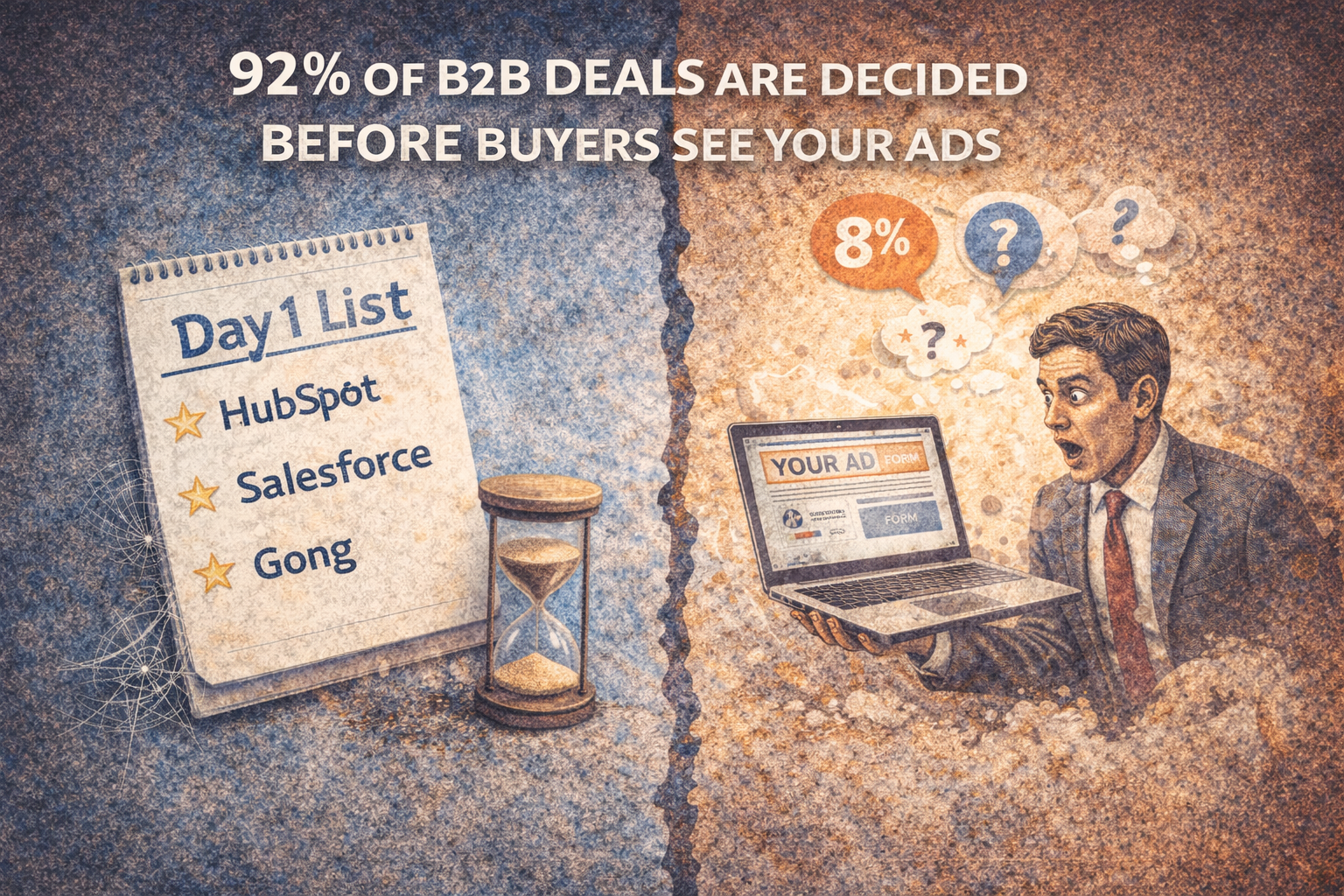
Recent research stopped me in my tracks: 92% of B2B deals are effectively decided before buyers ever see your ads.
Yes — before the demo requests, before the form fills, before someone reluctantly agrees to “just a quick intro call.”
Which means one thing: if your brand is not already on a buyer’s mental shortlist, you are probably competing for leftovers.
Welcome to what researchers call the Day 1 List.
The List That Quietly Decides Your Revenue
Right now, many B2B marketers are fishing with impressive gear… in a pond that has already been cleared out.
Research shows that when buyers enter the market, 92% choose from just two or three vendors already sitting in their heads.
Meanwhile, companies run LinkedIn Ads like search campaigns — chasing leads, celebrating cheap CPLs, and hoping urgency will magically appear.
But here is the problem:
People do not open LinkedIn thinking, “Time to urgently purchase enterprise software.”
They go there to learn, connect, procrastinate professionally, or consider a career change.
Buying happens later.
Memory happens first.
What Actually Happens Before Someone Books a Demo
A need appears. Budget gets approved. Someone says, “We need a solution.”
Then what?
They do not start with a comparison spreadsheet.
They ask themselves a much simpler question:
“Who do we already know that does this?”
That tiny mental roll call is the Day 1 List.
According to Bain and LinkedIn:
86% of buyers already have this list before researching
92% purchase from it
Only 8% buy from vendors who were not previously on their radar
Eight percent is not a strategy. It is a lottery ticket.
Where Most Teams Go Wrong
The shortlist is shrinking. Gartner data suggests buyers used to consider around six suppliers. Now it is closer to three or four.
That is not competition — that is musical chairs with fewer chairs every year.
If you are not seated before the music stops, your outbound campaigns, webinars, and nurture sequences are all battling for a single-digit probability.
And here is the kicker:
The Day 1 List is formed months — sometimes years — before a purchase.
You cannot rush familiarity.
Being Top of Mind Is a Memory Game
Marketers obsess over targeting: job titles, firmographics, intent data.
Useful? Yes. Sufficient? No.
Shortlist inclusion is fundamentally about memory.
The Ehrenberg-Bass Institute calls the triggers that prompt brand recall Category Entry Points — the situations that make buyers think of you automatically.
Examples look like this:
“We need better pipeline visibility” → Salesforce, HubSpot
“Our projects are chaos” → Asana, Monday
“Our documentation is everywhere” → Notion
These links are not built with one clever campaign. They are built through consistent exposure.
The brand most strongly tied to the buying situation gets remembered first.
Everyone else becomes “Who are these guys again?”
What This Means for LinkedIn Ads
Many companies run LinkedIn Ads backwards.
They focus entirely on the tiny percentage of buyers in-market today and ignore the far larger group quietly forming future preferences.
LinkedIn’s real strength is not harvesting demand — it is planting the seeds of familiarity long before demand exists.
Think of it less like paid search and more like a precision digital billboard.
Five Ways to Earn a Spot on the Day 1 List
1. Target the category, not just the obvious buyers
Intent data captures roughly 5% of the market. The other 95% are future buyers deciding who feels credible.
2. Optimize for frequency, not just clicks
One impression is forgettable. Repetition builds recognition.
3. Stay visible
Stop-start campaigns create stop-start memory. Consistency wins.
4. Lead with a perspective
Buyers remember companies that teach them something — not those that shout features.
Research shows 81% of winning vendors were known before evaluation began.
Familiarity is not luck. It is engineered.
5. Measure brand health, not just lead volume
Reach, awareness, and share of search often predict future pipeline better than this quarter’s CPL report.
Short-term metrics feel satisfying. Long-term metrics build companies.
The Budget Split That Makes Sense
Binet and Field recommend a 60/40 balance:
60% long-term brand building
40% demand capture
Many organizations flip it and then wonder why growth stalls.
Personally, I lean closer to 70/30 in favor of brand — but progress beats perfection.
The key is simple:
If buyers do not remember you, they cannot choose you.
And if they cannot choose you, your pipeline never had a chance.
More in the next edition.
