
Stop Selling Services. Start Selling Results
Most B2B content reads like a polite digital brochure.
We build websites.
We offer SEO.
We provide marketing solutions.
That’s nice.
But enterprise buyers are not sitting in boardrooms thinking:
“I really hope someone provides SEO.”
They’re thinking:
Will this increase revenue?
Will this improve ROI?
Will this reduce risk?
Will this create measurable business impact?
If your content doesn’t clearly answer those questions, you’re not speaking to decision-makers.
You’re narrating your own capabilities.
That’s where outcome-driven B2B content separates vendors from revenue partners.
Why Feature-Focused Content Falls Flat
Most B2B companies still describe themselves like this:
We build responsive websites.
We provide digital marketing services.
We offer SEO optimisation.
There’s nothing technically wrong with these statements.
They’re just commercially empty.
They don’t address revenue.
They don’t address performance.
They don’t address business risk.
Now compare that with:
We help B2B companies increase inbound revenue through conversion-focused digital platforms.
We build marketing systems that improve lead quality within your ICP.
We design digital infrastructure that drives measurable ROI.
Same services.
Completely different positioning.
The first version sounds like a supplier.
The second sounds like a growth partner.
And enterprise buyers are not searching for more suppliers.
Enterprise Buyers Think in Risk and Return
When a CFO, CMO, or founder evaluates a potential partner, they are calculating:
Expected ROI
Revenue upside
Operational efficiency
Long-term scalability
Risk mitigation
They are not evaluating how “beautiful” your website builds are.
Trust is built when your content reflects an understanding of commercial stakes.
Not when it lists deliverables.
Step 1: Start With the Business Problem, Not Your Service
Most companies introduce themselves like this:
We provide website development.
But your ideal customer profile is not worried about “website development.”
They’re worried about:
Low lead conversion
Outdated digital presence
Losing market share
Weak brand authority
High customer acquisition costs
Outcome-driven content begins with the commercial pain.
For example:
Many growing B2B companies lose revenue because their digital infrastructure fails to convert high-intent visitors into qualified leads.
Now you’re speaking to money.
Now you’re relevant.
Step 2: Translate Services Into Business Results
Look at how leading B2B brands position themselves.
They don’t lead with features.
They lead with impact.
They talk about:
Scalability
Cost optimisation
Productivity
Revenue growth
Sales and marketing alignment
They anchor messaging in:
Growth
Efficiency
Measurement
Strategic advantage
That is outcome language.
And outcome language changes perception.
Step 3: Connect Everything to ROI
Modern B2B buyers expect vendors to understand their business before they even speak to them.
Understanding the business means answering three simple questions:
How does this increase revenue?
How does this improve ROI?
How does this reduce cost or risk?
If your content doesn’t clearly address those points, you’re not operating at a strategic level.
You’re operating at a tactical one.
And tactical vendors compete on price.
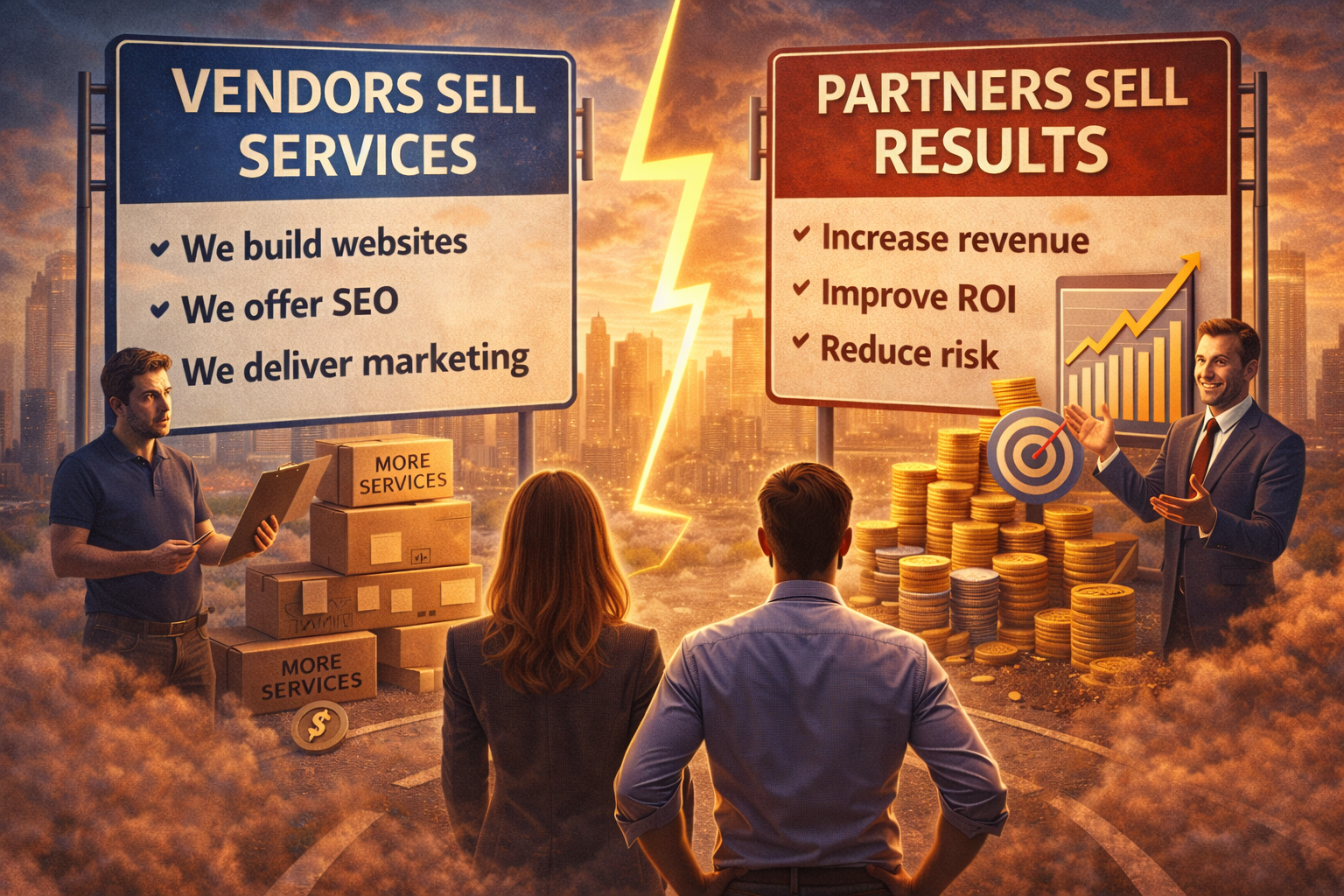
Vendors Sell Services. Partners Sell Results.
There’s a big difference between:
“We offer digital marketing.”
And:
“We help you build predictable revenue systems.”
One invites comparison shopping.
The other invites strategic conversation.
When your content focuses only on what you do, you compete on capability and cost.
When your content focuses on measurable outcomes, you compete on value.
And value closes enterprise deals.
