
If You’re Not on the Day 1 List, You’re Not in the Deal
Welcome to the first edition of this newsletter.
A logical place to start is with a question most B2B marketers quietly avoid:
Why are we spending money on LinkedIn Ads… and still missing pipeline?
Recently, research stopped me in my tracks:
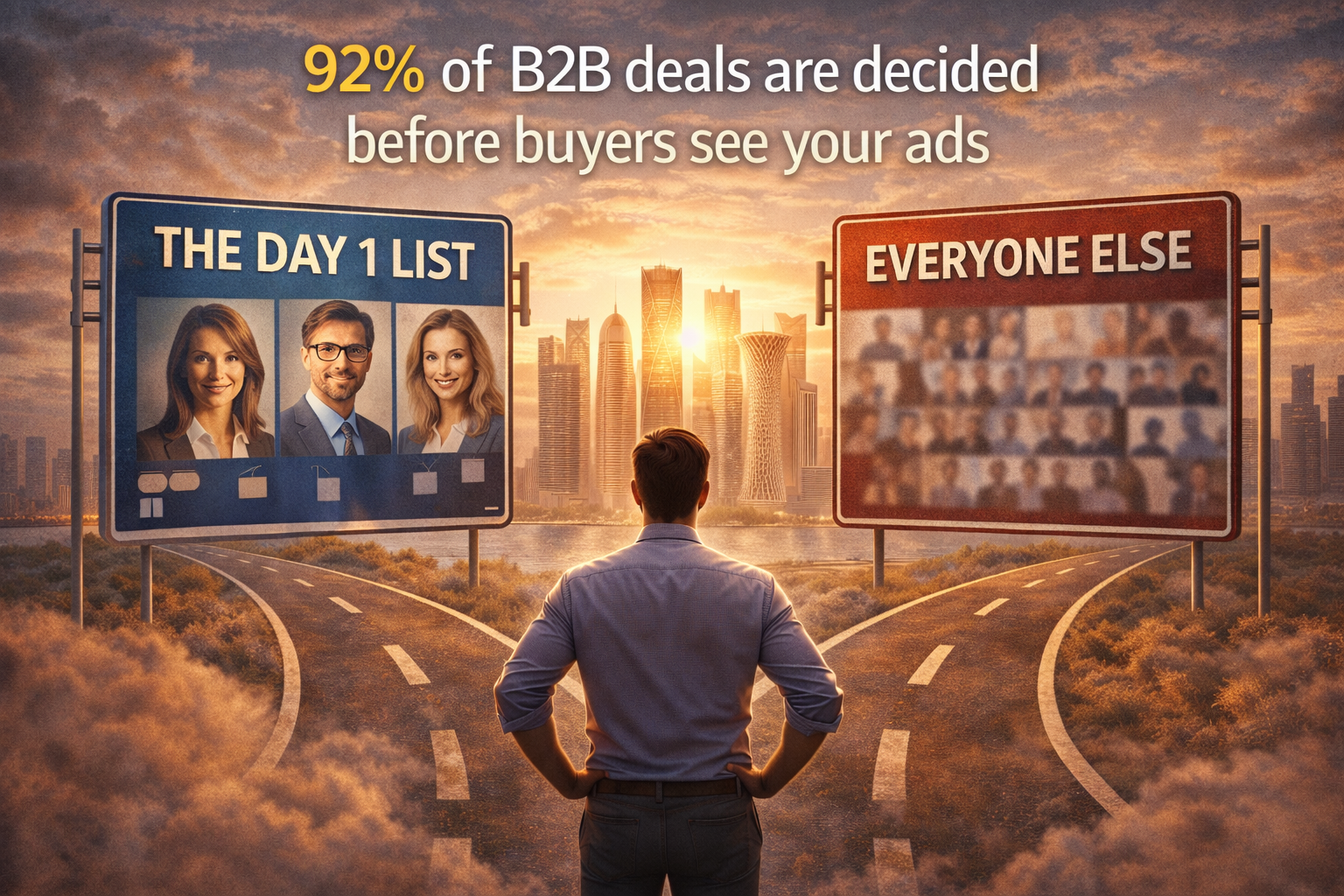
92% of B2B deals are decided before buyers ever see your ads.
Read that again.
Most of your pipeline is effectively decided before someone clicks, converts, or attends your webinar.
Which means one thing:
Your brand needs to be on what researchers call the Day 1 List.
In this edition, we’ll unpack:
What the Day 1 List actually is
Why 92% of B2B deals go to vendors already on it
And what LinkedIn Ads should be doing long before demand shows up
The List That Quietly Controls Your Pipeline
Right now, many B2B marketers feel like they’re fishing in an empty pond.
Leads are expensive. Conversion rates fluctuate. Form fills are inconsistent.
Meanwhile, 92% of B2B buyers choose from the 2–3 vendors that come to mind when they enter the market.
Yet most brands run LinkedIn Ads like Google Ads:
Capture demand
Chase leads
Optimise cost per acquisition
Expect quick wins
There’s one issue.
People don’t open LinkedIn to solve a pressing business problem.
They open it to learn, network, scroll, or look at job posts they may or may not apply for.
Which means the game is different.
What Actually Happens Before Someone Books a Demo
Here’s what real B2B buying looks like.
A need appears.
Budget gets approved.
Someone says, “We need a solution for this.”
And then?
They don’t immediately search “[category] software comparison.”
They don’t fill out a gated asset form.
They don’t attend your webinar.
They ask themselves a much simpler question:
“Who do we already know that does this?”
That shortlist — the two or three names that surface instantly — is the Day 1 List.
According to research from Bain and LinkedIn:
86% of B2B buyers have a Day 1 List before they formally begin researching
92% ultimately buy from someone already on that list
Only 8% of deals go to vendors who weren’t already mentally shortlisted.
Eight percent.
If you’re not on that list, you’re playing in the leftovers.
The Shortlist Is Shrinking
It used to be that buyers considered six vendors.
Now? Research from Gartner shows that number has shrunk to three or four.
Three or four slots.
Not ten.
Not “whoever has the best landing page.”
Not “whoever sends the most follow-ups.”
If you’re not in those top few names before the buying process starts, your outbound, your ABM, your retargeting — all of it — is competing for a single-digit probability.
And here’s the uncomfortable part:
The Day 1 List is formed months — sometimes years — before the buying event.
This Is a Memory Game, Not a Targeting Game
B2B marketers love targeting.
Firmographics.
Job titles.
Intent signals.
But inclusion on the Day 1 List isn’t primarily about targeting.
It’s about memory.
When a buying situation arises, people don’t scan the entire market. They retrieve a few brands from memory based on situation-specific triggers.
The Ehrenberg-Bass Institute calls these triggers Category Entry Points — the cues that connect a buying situation to a brand.
For example:
“We need better pipeline visibility.”
A few CRM brands immediately come to mind.
“Our team’s workflow is chaos.”
Certain project management tools surface instantly.
“LinkedIn isn’t generating pipeline.”
Ideally, your brand appears in that moment.
These associations aren’t built with one clever campaign.
They’re built through consistent, repeated exposure over time.
The brand most strongly linked to the buying situation gets recalled first.
Everyone else is competing for mental scraps.
What This Means for LinkedIn Ads
Most brands use LinkedIn Ads backwards.
They focus entirely on the small percentage of buyers actively in market right now.
But LinkedIn’s real power isn’t in harvesting existing demand.
It’s in building mental availability 6–18 months before someone becomes a buyer.
Think of LinkedIn as a digital billboard — but one that can precisely target your entire category.
Here’s how to use it properly.
1. Reach the Whole Category
You cannot predict when a buyer enters the market.
Intent data identifies the 5% actively shopping. The other 95% are forming opinions quietly.
If you only advertise to “in-market” buyers, you miss the real leverage.
2. Optimise for Frequency, Not Just Clicks
Memory requires repetition.
One exposure does not build recall. Ten might.
Consistent monthly frequency matters more than short bursts of performance spikes.
3. Stay Always-On
Stop-start campaigns create gaps in mental availability.
Brands that win show up consistently, with the same message and identity, week after week.
Familiarity compounds.
Silence resets the clock.
4. Lead With a Point of View
LinkedIn rewards perspective, not product pitches.
Research shows that 81% of winning vendors were known before formal evaluation began — not because of features, but because they had a clear, consistent stance in the market.
Features matter later.
Perspective gets you remembered.
5. Measure Brand, Not Just Leads
If you only optimise for cost per lead, you unintentionally kill long-term consideration.
Track:
Reach
Penetration
Share of search
Unaided awareness
These are leading indicators of future pipeline.
Leads are lagging indicators.
The Budget Split That Actually Makes Sense
Research from Binet and Field suggests a 60/40 split in favour of brand building.
60% long-term brand (reach and memory building)
40% short-term demand capture
Most B2B companies do the opposite.
If anything, in B2B with long sales cycles, pushing closer to 70/30 brand to demand often creates stronger long-term growth.
Step by step.
Final Thought
If your LinkedIn strategy is built entirely around capturing demand, you are competing for 8% of the market.
If your brand is consistently building memory months before demand appears, you are competing for 92%.
This isn’t about being loud.
It’s about being remembered at the right moment.
If you’re not on the Day 1 List, you’re not really in the deal.
