
Stop Chasing Cold Leads: Why Buying Intent Data Is Becoming B2B Sales' Biggest Advantage
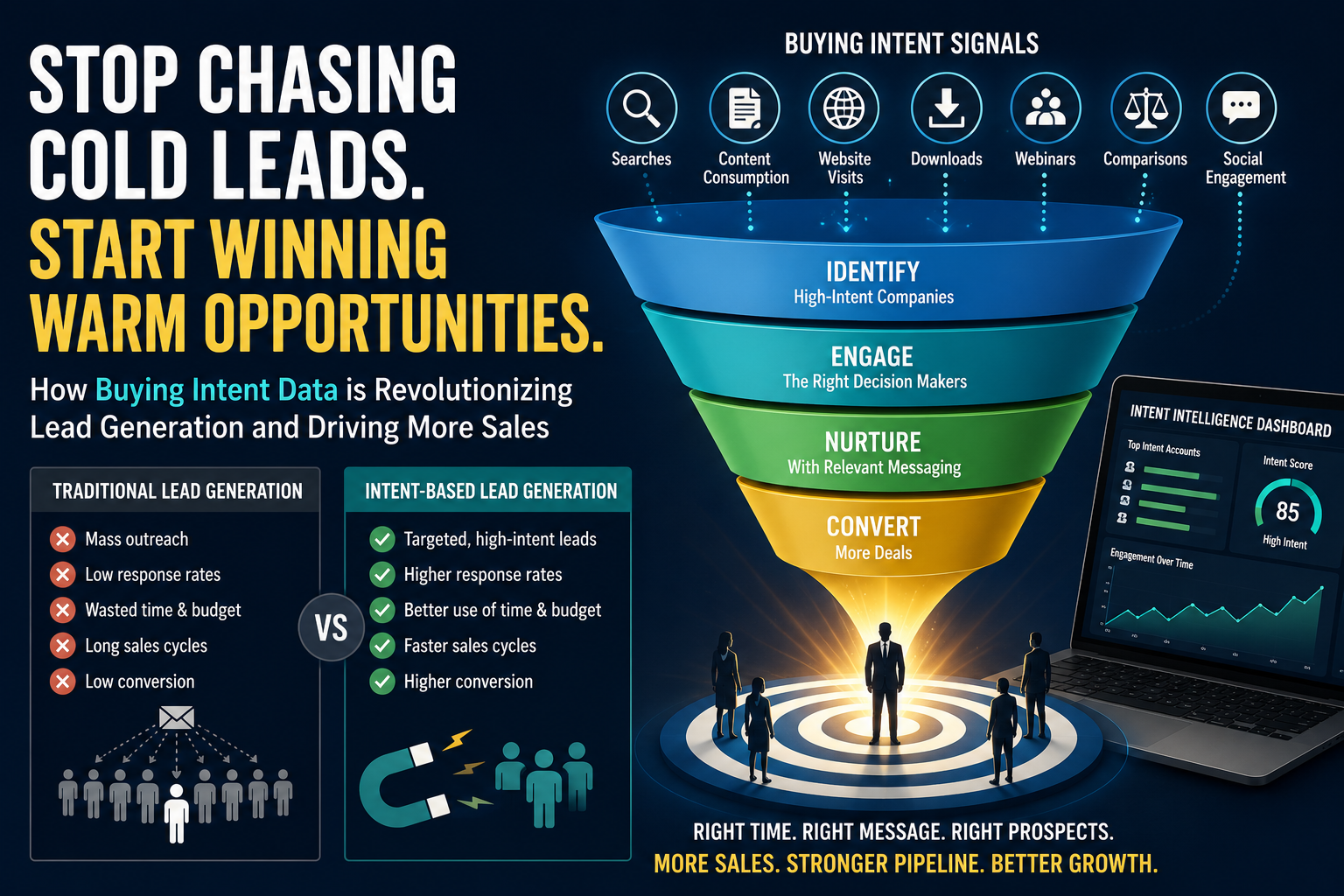
The Best Sales Calls Start Before You Pick Up the Phone
Every sales rep wants the same thing:
To talk to prospects who are already looking for a solution.
Not people who ignore emails.
Not people who downloaded one random ebook six months ago.
Not people who "might be interested next quarter."
Just buyers who are actively trying to solve a problem right now.
Sounds obvious.
Yet most B2B lead generation still works like this:
Build a list.
Send 1,000 emails.
Cross your fingers.
Blame the subject line.
The problem isn't usually the outreach.
It's timing.
And that's exactly why buying intent data has become one of the most valuable tools in modern B2B sales and marketing.
The Problem with Traditional Lead Generation
For years, prospecting was built around firmographic data:
Industry
Company size
Revenue
Employee count
Geography
Job titles
Useful? Absolutely.
Enough? Not even close.
Imagine you sell cybersecurity software.
You identify 1,000 companies that perfectly match your Ideal Customer Profile.
Great.
But:
Some just renewed with a competitor.
Some don't have budget approval.
Some aren't aware they have a problem.
Some won't revisit the topic until next year.
You have the right companies.
You just don't have the right timing.
And timing is often what separates ignored emails from booked meetings.
What Buying Intent Data Actually Tells You
Buying intent data helps answer the question traditional prospecting never could:
Who's actively looking for a solution right now?
It tracks digital behaviors that indicate research and buying activity.
Things like:
Searching industry-related keywords
Reading solution-focused content
Comparing vendors
Visiting product pages
Downloading reports
Attending webinars
Reading review sites
Consuming educational content
Researching competitors
Every one of these actions leaves a trail.
And that trail often reveals who's entering a buying cycle long before they fill out a contact form.
Why Timing Beats Volume
Consider two scenarios.
Scenario 1
A company isn't thinking about your category.
You send an email.
They ignore it.
You send a follow-up.
They ignore that too.
You convince yourself everyone hates email.
Scenario 2
That same company is actively researching solutions.
Your email arrives.
They open it.
They reply.
A meeting gets booked.
Same offer.
Same company.
Same salesperson.
Different timing.
That's the power of intent data.
Why Lead Quality Improves Overnight
One of the biggest advantages of intent-based prospecting is simple:
You stop treating every prospect equally.
Instead, you prioritize:
Companies showing active buying signals
Decision-makers consuming relevant content
Accounts evaluating vendors
Buyers researching solutions similar to yours
The result?
Less guessing.
More conversations.
Better opportunities.
Five Ways Intent Data Improves Sales Performance
1. Higher Response Rates
People researching a problem are naturally more receptive to solutions.
Shocking, I know.
Your outreach becomes relevant instead of random.
2. Better Conversion Rates
Intent-based prospects already understand:
The problem
The urgency
The need for a solution
You're no longer creating awareness.
You're joining an existing conversation.
3. More Productive Sales Teams
Sales reps spend less time hunting.
More time closing.
And fewer hours wondering why nobody replied to the "just checking in" email.
4. Lower Customer Acquisition Costs
When marketing targets buyers who are already showing interest:
Ad spend becomes more efficient
Conversion rates improve
Waste decreases
The CFO suddenly stops asking uncomfortable questions.
5. Faster Sales Cycles
Buyers who are already researching solutions need less education.
They're closer to a decision.
Which means deals move faster.
Intent Data Alone Isn't Enough
This is where many companies get it wrong.
Intent data is not magic.
It's a signal.
The real value comes from combining it with:
Step 1: Identify High-Intent Accounts
Find companies actively showing buying behavior.
Step 2: Find Decision-Makers
Locate:
CEOs
Founders
Sales Leaders
Marketing Leaders
Operations Executives
Technology Buyers
Step 3: Verify Contact Information
Bad data turns good intent into bad outreach.
Step 4: Personalize Your Message
Reference what matters to them.
Not what matters to you.
Step 5: Follow Up Consistently
Most deals aren't won on the first touch.
They're won by showing up at the right time and staying relevant.
Why Personalization Matters More Than Ever
Intent data tells you who is interested.
Personalization tells them why they should care about you.
Generic outreach says:
"We help companies improve efficiency."
Personalized outreach says:
"I noticed your team has been researching customer retention solutions. Here's what we've seen work for companies facing the same challenge."
One gets deleted.
The other starts conversations.
The Competitive Advantage Nobody Talks About
The biggest benefit of intent data isn't better targeting.
It's getting there first.
The first vendor in a buying conversation often gains a significant advantage.
They:
Shape requirements
Influence evaluation criteria
Build trust earlier
Establish credibility
By the time competitors show up, the buyer already has a favorite.
The Future of Lead Generation Isn't More Leads
The future isn't bigger lists.
It's smarter lists.
The most successful B2B organizations are moving toward:
Intent-driven prospecting
Predictive analytics
Account-based marketing
Personalized outreach
Data-driven sales execution
Because the companies that win aren't always the ones contacting the most prospects.
They're the ones contacting the right prospects at exactly the right moment.
Final Thought
For years, lead generation was a volume game.
Today, it's becoming a timing game.
Buying intent data doesn't guarantee sales.
But it dramatically improves your odds of reaching buyers when they're actually ready to listen.
And in B2B, that's often the difference between another ignored email and your next closed deal.
