
In B2B Ecommerce, "In Stock" Isn't Enough Anymore
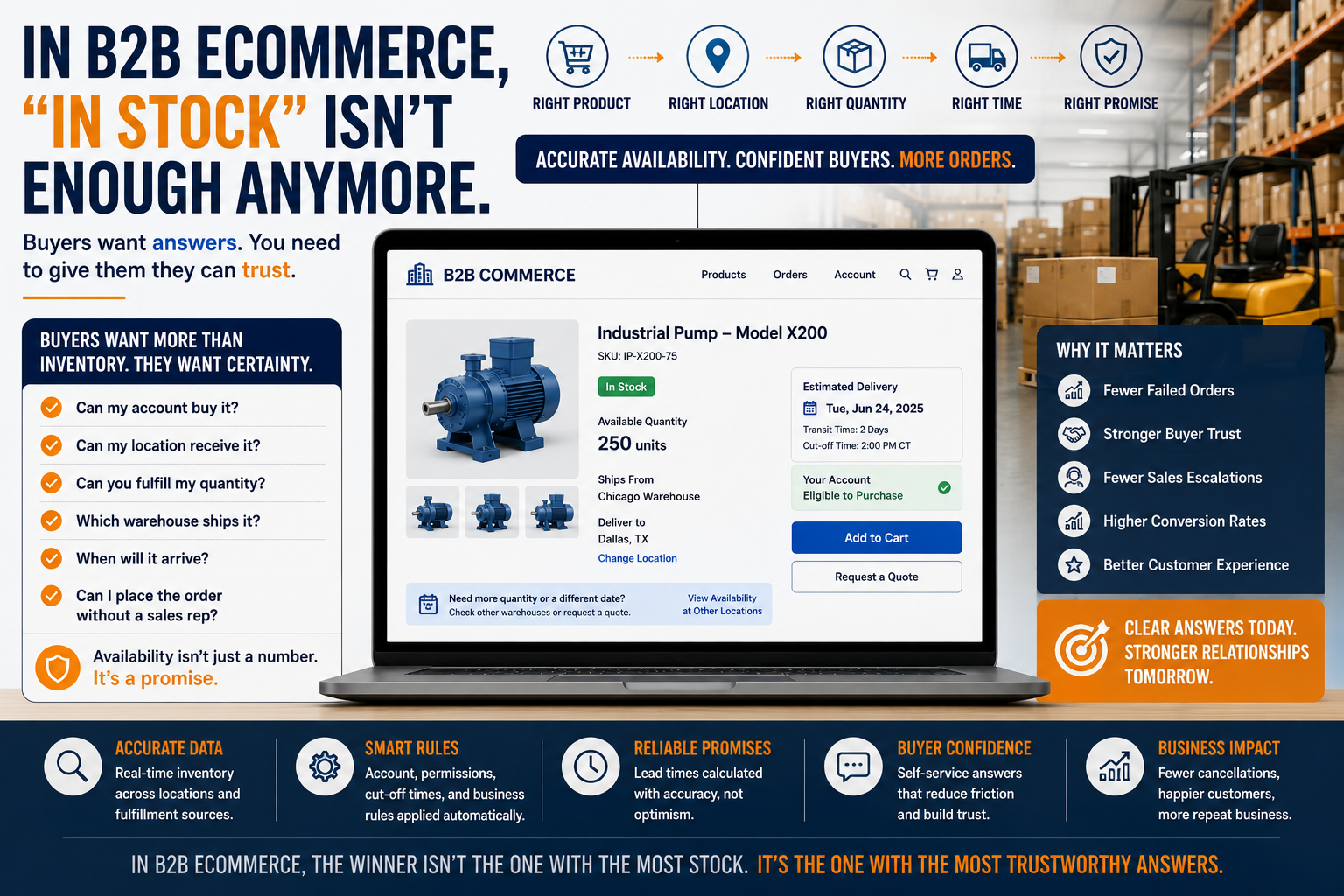
For years, B2B ecommerce treated availability as a simple question:
"Is it in stock?"
Yes or no.
Problem solved.
Except it wasn't.
Modern B2B buyers don't just want inventory visibility. They want certainty.
They want to know:
Can my company buy it?
Can my location receive it?
Can you fulfill the quantity I need?
Which warehouse will ship it?
Will changing locations affect delivery time?
Can I complete the order without emailing three sales reps and waiting until next Tuesday?
In other words, buyers aren't looking for stock levels.
They're looking for promises.
And the companies that can provide trustworthy answers are gaining a significant competitive advantage.
The New Reality of B2B Buying
B2B purchasing has changed dramatically.
Buyers now expect the same speed and transparency they experience as consumers, but with far more complexity behind the scenes.
Today's procurement teams conduct extensive research before ever contacting a salesperson.
Many would actually prefer not to contact one at all.
They want self-service answers.
Fast.
Accurate.
Available 24/7.
Unfortunately, many B2B ecommerce experiences still operate like it's 2012.
Product pages proudly display:
"Contact Sales for Availability."
Translation:
"We have the information. We just don't want to show it."
Not exactly a conversion booster.
Availability Is Really About Trust
The biggest mistake companies make is thinking availability equals inventory.
It doesn't.
Inventory is an internal number.
Availability is a customer promise.
And those are very different things.
A buyer doesn't care that you have 5,000 units sitting in a warehouse.
They care whether 500 units can arrive at their facility by next Thursday.
That's the answer they're trying to buy.
When companies fail to provide that answer, uncertainty takes over.
And uncertainty is where deals go to die.
Why Overpromising Is Even Worse
Of course, showing availability data comes with risks.
Nobody wants to promise a delivery date that turns out to be wildly optimistic.
We've all experienced that online order that promised:
"Arrives Friday."
Then quietly became:
"Arrives sometime before retirement."
In B2B, the consequences are much bigger.
A delayed shipment can impact production schedules, customer commitments, revenue targets, and a procurement manager's blood pressure.
That's why availability systems need to balance transparency with accuracy.
The goal isn't making aggressive promises.
The goal is making reliable ones.
AI Is Raising The Stakes
The rise of AI-assisted procurement is changing expectations even further.
Buyers increasingly rely on intelligent systems to compare suppliers, evaluate options, and make purchasing decisions.
AI doesn't like ambiguity.
Neither do buyers.
If your platform can't clearly answer availability questions, another supplier's platform probably can.
The organizations winning in digital commerce are building systems that can provide accurate, account-specific answers instantly.
Not eventually.
Not after an email.
Not after a callback.
Immediately.
The Future Belongs To Reliable Promises
The next generation of B2B ecommerce won't be defined by product catalogs.
It will be defined by confidence.
Buyers want to know what they can buy, how much they can buy, when it will arrive, and whether that promise can be trusted.
Companies that solve this problem reduce sales friction, improve buyer confidence, and create stronger digital experiences.
Because in modern B2B commerce, the question isn't:
"Do you have inventory?"
The question is:
"Can I trust your answer?"
