
Why Most B2B SEO Strategies Generate Traffic... But Not Buyers
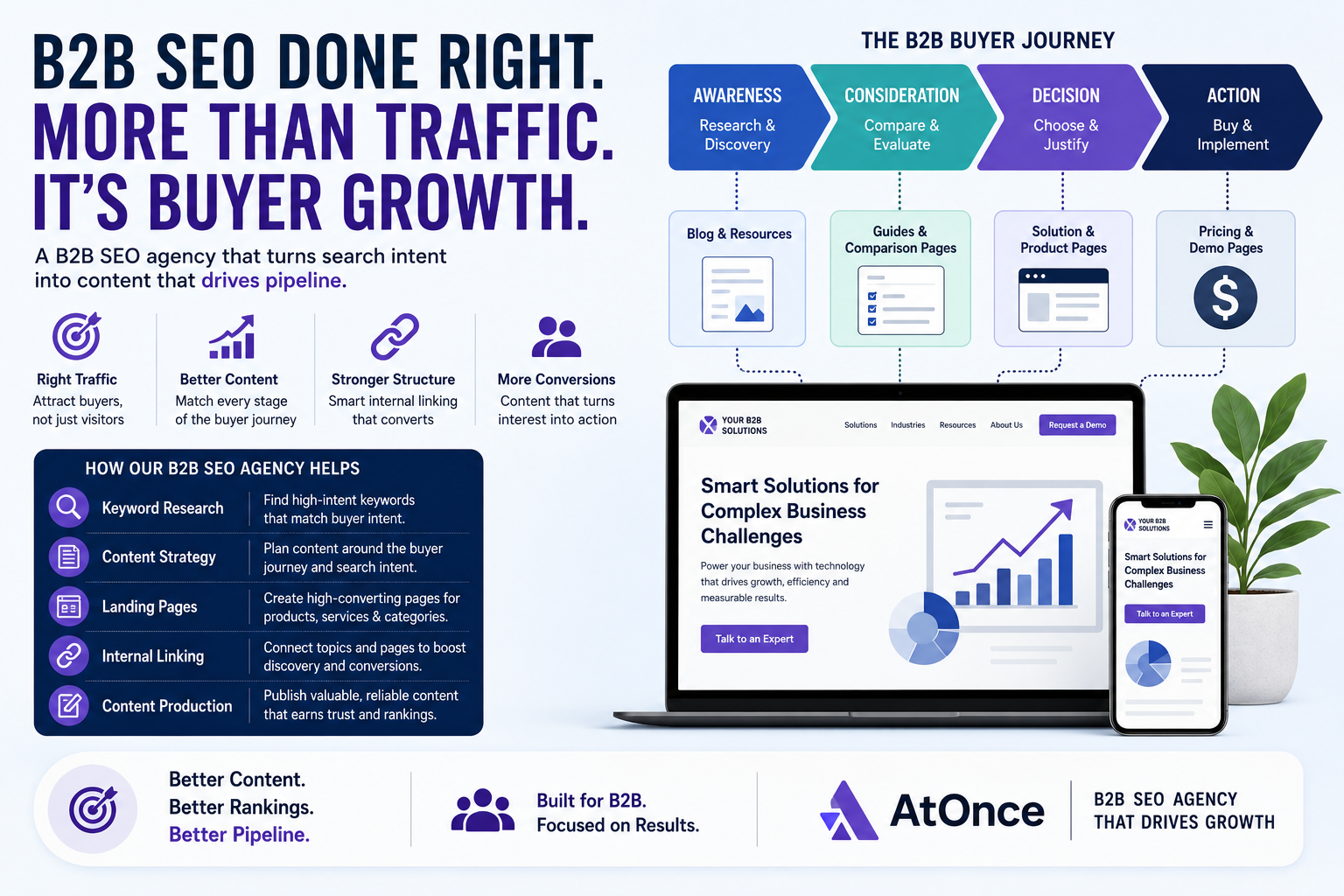
Traffic Is Easy. Buyer Intent Is Hard.
A lot of B2B companies invest heavily in SEO.
Keyword research gets done.
Content calendars get approved.
Blogs get published.
Traffic graphs start moving up and to the right.
Everyone celebrates.
Then someone asks the awkward question:
"How many actual buyers did we get?"
Silence.
The reality is that B2B SEO isn't about attracting the largest audience. It's about attracting the smallest audience that can actually buy from you.
And that's where most SEO strategies fall apart.
B2B Buyers Don't Search Like Normal Humans
Consumer search is usually simple.
Someone wants running shoes.
They search.
They compare.
They buy.
B2B buying looks more like an FBI investigation.
Buyers compare vendors.
Review alternatives.
Read analyst reports.
Download resources.
Visit pricing pages.
Get distracted.
Return three weeks later.
Bring colleagues into the conversation.
Then repeat the entire process again.
The journey is longer, messier, and filled with people who enjoy saying things like:
"Let's revisit this next quarter."
That's why B2B SEO requires a completely different approach.
SEO Should Follow The Buyer Journey
The best SEO strategies aren't built around keywords.
They're built around buyer behavior.
Every search query sits somewhere in the buying process.
Some buyers are simply exploring.
Others are actively comparing solutions.
Some are one procurement meeting away from making a decision.
Your content needs to serve all three.
That means creating pages that match how buyers actually research:
Educational content for discovery
Industry-specific pages for relevance
Comparison pages for evaluation
Product and solution pages for decision-making
FAQ content for objections and concerns
When these assets work together, SEO becomes more than traffic generation.
It becomes a sales-support system.
Most SEO Programs Have A Missing Middle
Many companies publish plenty of blog content.
Others focus heavily on product pages.
Very few build what's sitting in the middle.
And that's often where buyers make decisions.
The missing content usually includes:
Use case pages
Industry-specific solutions
Competitor comparisons
Alternative pages
Feature deep-dives
ROI-focused content
Buying guides
Without these assets, buyers arrive on your site and immediately have another question.
Then another.
Then another.
Eventually they leave to find someone who answered them faster.
Why More Blog Posts Won't Save You
There's an old SEO strategy that goes something like this:
"If we publish enough content, something will rank."
Technically true.
A monkey throwing darts might eventually hit the bullseye too.
The problem is that publishing more content doesn't automatically create more revenue.
Buyers aren't searching for "more content."
They're searching for answers.
The highest-performing B2B content is usually:
Specific
Practical
Commercially relevant
Aligned with buyer intent
Easy to navigate
Ten useful pages will often outperform one hundred generic blog posts.
Internal Linking Is More Powerful Than Most Teams Realize
Most companies treat internal links like an afterthought.
A few links here.
A few links there.
Good enough.
Not quite.
Internal linking helps buyers move naturally through the research process.
It also helps search engines understand how topics connect.
Think of it as building highways between your best content rather than forcing visitors to wander around looking for exits.
Good internal linking creates better discovery.
Better discovery creates better engagement.
Better engagement creates more opportunities.
Funny how that works.
What Lean Marketing Teams Need Most
Many B2B marketing teams aren't struggling because they lack ideas.
They're struggling because they lack time.
SEO requires:
Research
Planning
Writing
Updating
Publishing
Optimization
And somehow that's supposed to happen between meetings, reporting, campaign launches, and the seven "quick questions" that arrive before lunch.
The solution isn't necessarily adding more people.
It's creating a content system that consistently turns search insights into useful assets buyers actually need.
How To Evaluate A B2B SEO Partner
Most SEO pitches sound remarkably similar.
More traffic.
More rankings.
More visibility.
The better question is:
How does this connect to revenue?
A strong B2B SEO partner should clearly explain:
How keywords are prioritized
How content supports the buyer journey
How landing pages drive conversions
How internal linking supports movement through the funnel
How content production is managed and measured
Because rankings are great.
Revenue is better.
The Real Goal Of B2B SEO
The purpose of SEO isn't to win a traffic contest.
It's to help buyers find answers when they're actively looking for them.
The companies that win aren't always the ones publishing the most content.
They're the ones creating the clearest path between a buyer's question and their solution.
When that happens, SEO stops being a marketing activity.
It becomes a growth engine.
