
Why B2B Should Stop Copying B2C — and Start Acting Like Activism
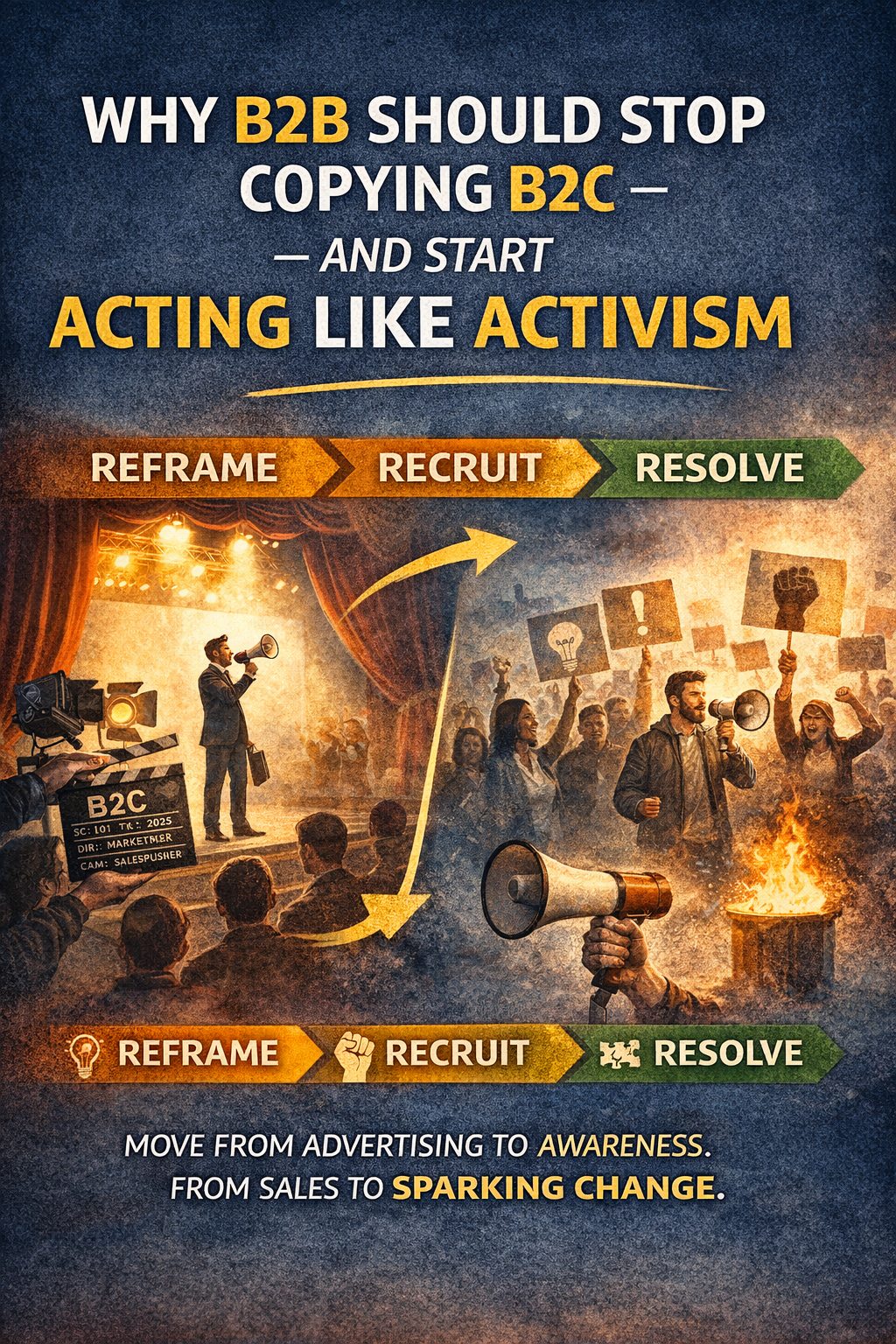
Why B2B Should Stop Copying B2C — and Start Acting Like Activism
For years, I looked to B2C as the way to “fix” B2B creativity.
Now, I look somewhere else entirely: activism.
This is my argument for a different kind of B2B creativity — one grounded in empathy and designed to trigger the kind of realization that actually changes behavior.
Let’s be honest: B2B creativity has had an identity problem. It’s long been mocked for being dull, overly rational, and painfully safe. The industry’s response was predictable: add emotion. Make it feel more like B2C.
For a while, that felt right. I believed it too.
But in hindsight, it was a shortcut. We borrowed from B2C without ever defining what B2B creativity should be on its own terms. We copied the loudest kid in class and called it progress.
The real question we should have been asking was simpler — and harder:
What does great B2B creativity actually look like?
Now, I think we’re finally closer to an answer.
A Distinct Identity for B2B Creativity
I believe great B2B creativity should create an epiphany.
It should wake people up to a problem they’ve grown used to — maybe even resigned themselves to — and push them to act.
But epiphanies don’t happen by accident.
They start with strategy. And real strategy is empathy.
Not surface-level understanding, but deep immersion in how your audience actually lives with their problem. The stakes. The frustration. The thoughts they don’t always articulate but feel every day.
When you truly see the world through their eyes, you’re no longer analyzing your audience — you’re becoming them. That’s when you can speak in their voice and land a message that resonates.
That message is the strategic proposition. At alan., we call it the provocation.
But provocation alone doesn’t change behavior.
How to Turn Provocation into an Epiphany
Strategy needs creativity to move from insight to impact. To transform a message into a story that drives change.
In our work, that happens through three actions: reframe, recruit, resolve.
Reframe means taking something familiar and revealing it in a new way. The goal is to give the audience a different understanding of the problem — one they don’t just grasp intellectually, but feel emotionally.
Recruit means activating agency. Tension. Urgency. The moment when acceptance turns into discomfort. Internally, we call it the “oh, this is bad” moment — when the audience realizes they can’t ignore the problem anymore.
Resolve is the final act. A strong idea doesn’t just dramatize pain; it points to a way out. This is where the product or service enters the story — not as an afterthought, but as the enabler of change.
In the best B2B work, the product isn’t the hero. It’s the tool that helps the audience finally win.
We’re not saying, “Buy this because we sell it.”
We’re saying, “Here’s your reality. Here’s why it hurts. And here’s how to fix it — with our help.”
What This Looks Like in Practice
Let’s ground this in reality.
In our recent campaign for Veeam, the provocation was simple: Take cybersecurity seriously.
When we spent time with CISOs, we realized their experience wasn’t just defined by vigilance — it was defined by frustration. Many felt unheard by boards and executives who underestimated the severity of the risks.
The real fear wasn’t the threat itself.
It was being the only one who truly saw it.
So we reframed the problem.
We placed the C-suite inside horror movie scenarios — making the danger obvious and unavoidable to everyone except the people ignoring it. Suddenly, the threat wasn’t abstract. It was visible, uncomfortable, and impossible to dismiss.
That’s how we recruited them.
By triggering that jolt of realization — the moment when complacency breaks and urgency takes over. From there, we showed a path forward: directing audiences to a thought-leadership hub that helped CISOs bring their organizations on the journey with them.
That’s how Veeam became more than a vendor. It became an advocate for cybersecurity and data resilience.
And that’s how brands become agents of progress.
Final Thought
So no — B2B creativity shouldn’t try harder to be like B2C.
It should be more like activism.
Because the goal isn’t just to move people emotionally.
It’s to create epiphanies.
The kind that lead to real, lasting change.
