
Trust After Scale: Why B2B Buyers Are Slowing Down in the Age of AI
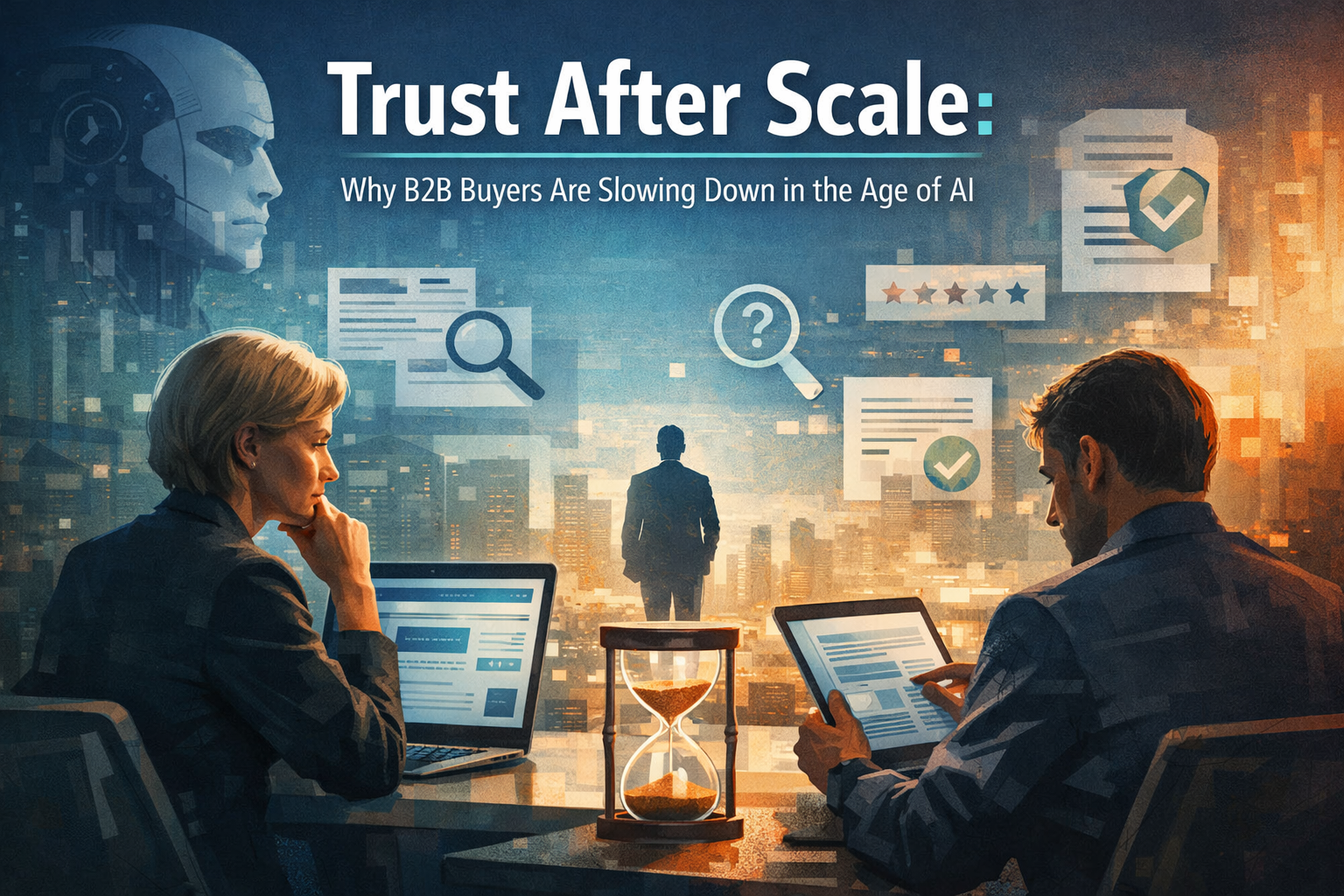
The Buyer Behavior That’s Changing—Quietly
Think back to the last time a B2B page gave you enough certainty to stop searching.
Not interest.
Not inspiration.
Certainty.
For many buyers, that moment is becoming harder to reach.
It’s not because AI-written content turns them off. Most buyers don’t care how content is produced. What they do notice is how much information now looks equally polished—and how little of it feels immediately dependable.
As we move deeper into 2026, buyers aren’t pushing back loudly. They’re adjusting silently.
They reread.
They cross-check.
They delay decisions.
Trust hasn’t vanished.
It’s just no longer assumed.
The Invisible Drag on B2B Decisions
Imagine a buyer comparing two vendors.
Both websites are well-written. The messaging is clear. The value propositions sound familiar—and reassuring.
Nothing raises a red flag.
Yet something feels incomplete.
So the buyer opens another tab. Maybe a review site. Maybe a LinkedIn post. Maybe a peer conversation. They’re looking for validation that doesn’t originate from the company itself.
That pause is the cost of modern content abundance.
When high-quality language becomes easy to generate, buyers instinctively verify before believing. Each verification step introduces friction—small on its own, but powerful in aggregate.
The result isn’t rejection. It’s hesitation.
Sales cycles stretch. Momentum thins. Confidence wavers—not because buyers distrust brands, but because trust now requires confirmation.
Buyers aren’t disengaging.
They’re auditing.
What Actually Persuades Buyers Now
Persuasion still works—but the bar has moved.
Strong language alone no longer carries authority. AI made confidence cheap. Buyers learned to look beyond tone and structure to assess substance.
Today, credibility shows up in different ways:
Claims that are framed with context, not absolutes
Examples that reflect real-world constraints, not ideal scenarios
Insights that feel earned through experience, not assembled from patterns
This isn’t about turning marketing into legal documentation. It’s about anchoring persuasion to something defensible.
Proof doesn’t replace persuasive writing.
It stabilizes it.
Why Ownership Matters More Than Output
Speed is no longer the competitive edge it once was.
Most B2B teams can produce content quickly now. Drafts appear instantly. Campaigns multiply. Ideas are rarely the bottleneck.
Judgment is.
What deserves publication?
What needs clarification?
What sounds good but can’t hold up under scrutiny?
Examples show up everywhere:
A statistic that looks accurate but can’t be sourced confidently
A bold claim that collapses when someone asks “under what conditions?”
A case study that reads well but doesn’t match how customers actually operate
In 2026, effective B2B content isn’t defined by writing quality alone. It’s defined by accountability.
Someone must be able to explain what’s published, revise it if needed, and stand behind it publicly. That kind of ownership doesn’t slow teams—it prevents costly backtracking later.
What Changes When Buyers Feel Sure
When content feels grounded, buyers move forward with less resistance. They don’t need to decode language or validate every assertion externally. The content does more of the work upfront.
When content feels generic or overly polished, buyers compensate by slowing down. Not because they’re cynical—but because they’ve learned caution is rational.
The brands gaining traction aren’t trying to sound more impressive. They’re choosing to be clearer.
They show how claims were formed.
They explain reasoning, not just conclusions.
They reduce ambiguity instead of relying on flourish.
Clarity reduces friction. And in B2B, reduced friction means faster decisions, cleaner sales conversations, and fewer downstream surprises.
Trust isn’t a soft value.
It’s a functional advantage.
Where Content Integrity Is Headed
This shift isn’t driven by fear of AI or regulatory pressure. It’s driven by buyer adaptation.
Content integrity has quietly become part of the buying experience itself.
The most effective B2B teams in 2026 won’t be the ones publishing the most. They’ll be the ones supervising content intentionally—knowing where human judgment is required, where nuance matters, and where silence is better than speculation.
Trust hasn’t eroded.
Buyers are simply paying closer attention to how information is constructed, supported, and owned.
Brands that respond to this don’t feel louder.
They feel more stable.
And in crowded markets, that stability creates confidence long before a sales call ever happens.
What changes are you seeing in how buyers respond to content—or how your own team evaluates what’s ready to publish?
If questions around content integrity or AI oversight are showing up in your workflow, I’m always open to talking it through.
Thanks for reading. More soon.