
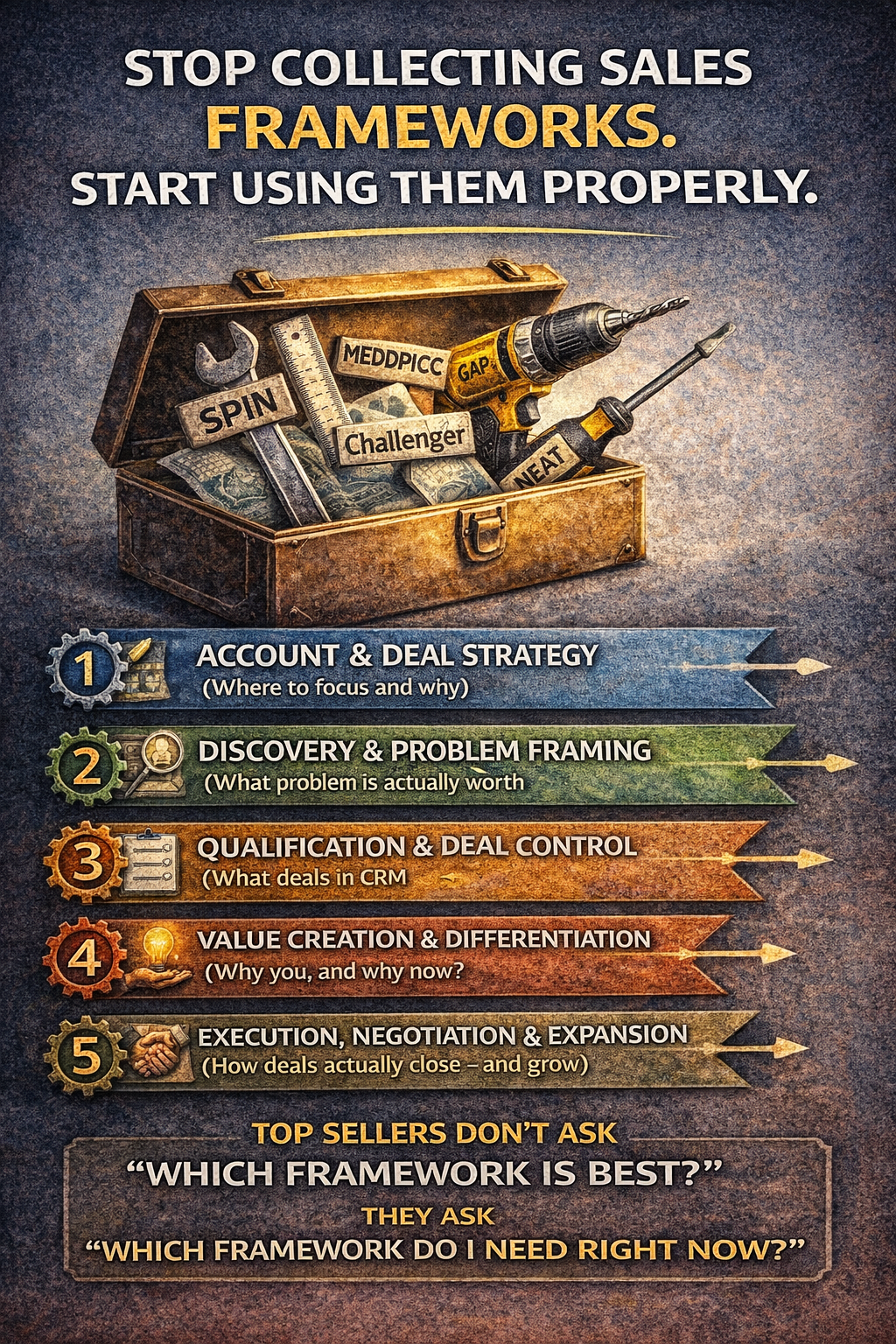
Stop Collecting Sales Frameworks. Start Using Them Properly.
Sales frameworks are everywhere.
SPIN. MEDDPICC. Challenger. GAP. NEAT. Target Account Selling.
Most sellers can name them.
Very few know when to use them.
Almost no one combines them correctly.
Top performers don’t treat frameworks like Pokémon cards. They don’t try to “catch them all.” They cluster them by purpose and apply them at the right moment in the deal lifecycle.
Below is a practical, real-world way to do exactly that—no theory, no buzzwords, just how complex B2B deals actually get done.
Cluster 1: Account and Deal Strategy
Where to focus and why
Frameworks
Target Account Selling
Political Mapping / Command of the Sale
Competitor Matrix
What this cluster solves
Who is worth selling to
Who really decides
Where you win—and where you lose
This cluster runs before and throughout the deal. Its main job is preventing wasted effort, bad-fit accounts, and single-threaded disasters.
How it works in practice
Identify high-value accounts based on ICP, revenue potential, and strategic fit
Map power, influence, blockers, and champions
Position against competitors on real differentiation, not feature checklists
Real B2B example
Enterprise industrial equipment deal (€1.5M)
Cluster 2: Discovery and Problem Framing
What problem is actually worth solving?
Frameworks
SPIN Selling
GAP Selling
Solution Selling (Diagnose Before Prescribe)
What this cluster solves
Customers who “like” you but never move
Feature dumping
Weak urgency
This cluster creates clarity, tension, and momentum.
How it works in practice
SPIN surfaces explicit and hidden pain
GAP Selling quantifies current state versus future state
Solution Selling prevents premature pitching
Real B2B example
Manufacturing analytics SaaS
Cluster 3: Qualification and Deal Control
Is this deal real—and winnable?
Frameworks
MEDDPICC
NEAT Selling
What this cluster solves
Fake deals in CRM
End-of-quarter surprises
“Procurement suddenly killed it”
This cluster is about truth, not optimism.
How it works in practice
MEDDPICC validates metrics, process, paper, and power
NEAT sharpens focus on need, economic impact, access, and timing
Real B2B example
IT infrastructure outsourcing deal
Cluster 4: Value Creation and Differentiation
Why you, and why now?
Frameworks
Challenger Sale
Value Proposition Design
Pain Chain Development
What this cluster solves
“You all look the same”
Price pressure
Decision paralysis
This cluster changes how the customer thinks.
How it works in practice
Challenger reframes the problem in uncomfortable but useful ways
Pain Chains connect user pain to management impact and executive risk
Value is framed in outcomes, not features
Real B2B example
Energy efficiency solutions for data centers
Cluster 5: Execution, Negotiation, and Expansion
How deals actually close—and grow
Frameworks
Command of the Sale
Negotiation Management
Land and Expand
What this cluster solves
Endless meetings
Scope creep
One-off wins with no growth
This cluster turns momentum into contracts and long-term accounts.
How it works in practice
Sellers lead the process instead of reacting to it
Negotiation focuses on value trade-offs, not discounts
The first deal is designed as a platform for expansion
Real B2B example
Global software rollout
The Biggest Mistake Sellers Make
They ask:
“Which framework is best?”
Top performers ask:
“Which framework do I need right now?”
Frameworks are not beliefs. They are tools.
And tools only work when used deliberately, together, and in context.
Final Thought
If you master:
Strategy
Discovery
Qualification
Value creation
Execution
You stop chasing deals.
You start orchestrating them.
Which framework do you rely on most today—and which one are you underusing?
