
Stop Chasing Demand—Start Building Buyer Confidence Instead
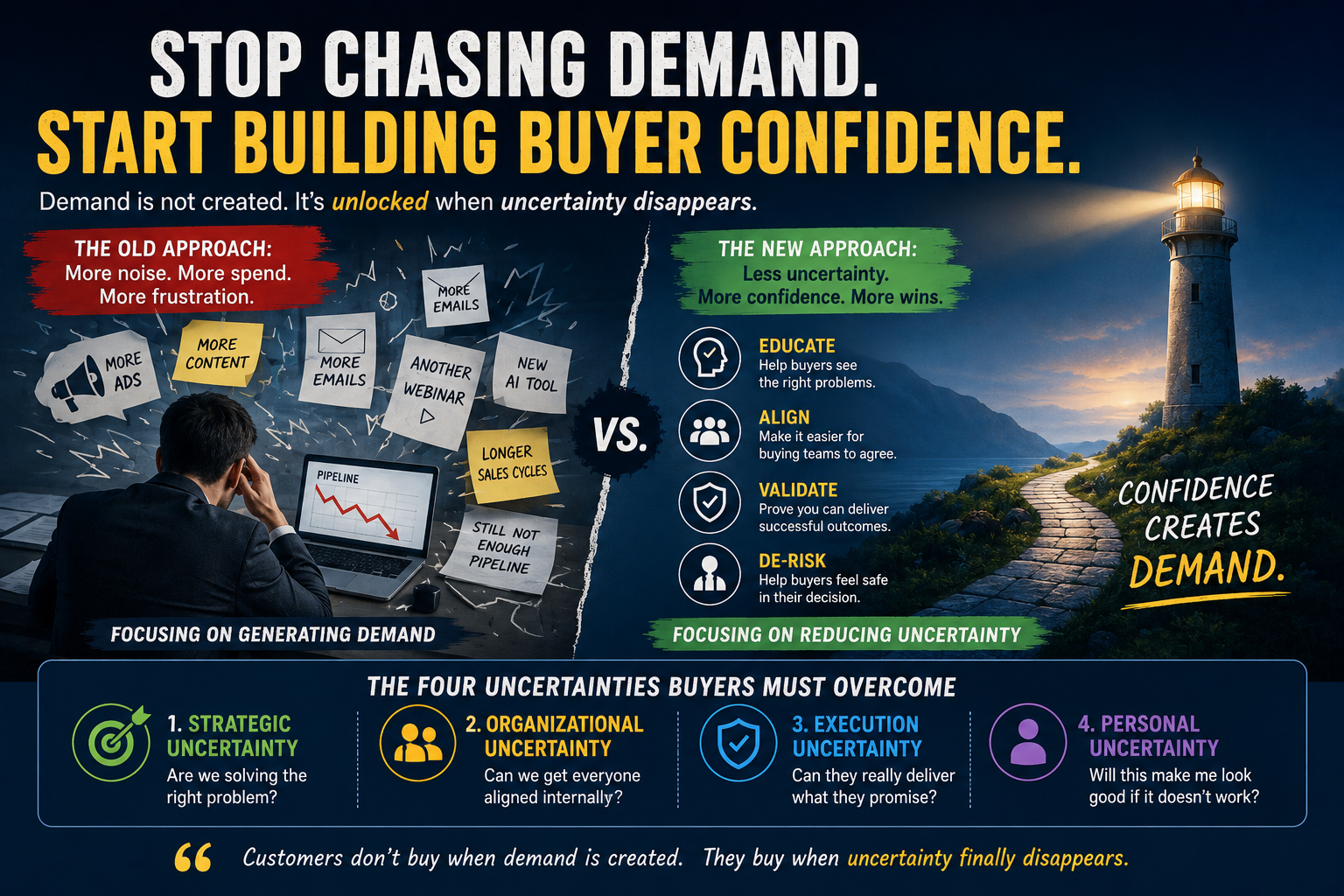
For years, B2B marketers have been asking the same question:
"How do we generate more demand?"
It's a fair question... but it might also be the wrong one.
A better question is:
"What's stopping buyers from making a decision in the first place?"
That small shift changes everything.
Most companies respond to a slow pipeline by doing what marketers do best: launching more campaigns, creating more content, hosting more webinars, buying another shiny AI tool, and hoping the marketing gods finally smile upon them.
Yet customer acquisition costs keep climbing, buying cycles keep stretching, and standing out gets harder every year.
Maybe the problem isn't that we're creating too little demand.
Maybe we're creating too much noise.
Demand Isn't Created. It's Unlocked.
Modern buyers don't wake up craving another whitepaper.
They crave confidence.
Research from Gartner suggests B2B buying groups spend only a small portion of their buying journey speaking with vendors, while 6sense reports that buyers often complete most of their research before engaging with sales.
That doesn't mean buyers dislike vendors.
It means they don't like uncertainty.
Every Google search, analyst report, LinkedIn post, customer review, and peer recommendation serves one purpose:
Helping buyers feel confident enough to say "yes."
Marketing's biggest job isn't convincing people.
It's removing the doubts that stop them.
Great Marketing Makes Buyers Feel Smarter
The brands that dominate their industries rarely win because of flashy campaigns.
They win because they reshape how buyers think.
Take Salesforce.
Its famous "No Software" campaign wasn't really about CRM features.
It challenged the entire idea that enterprise software had to live on clunky on-premise servers.
HubSpot did something similar.
Instead of shouting, "Buy our software!"
They spent years teaching marketers why inbound marketing worked.
By the time buyers were ready to purchase, HubSpot already felt like the obvious choice.
NVIDIA has followed the same playbook by helping businesses see AI as an inevitable business transformation—not just another tech trend.
The lesson?
Great marketing doesn't force demand.
It removes doubt until buying feels inevitable.
Every Buyer Has Four Big Questions
Behind every purchase sits a committee of cautious humans wondering whether they'll regret clicking "Approve."
Most deals stall because one (or more) of these uncertainties remains unanswered.
1. Strategic Uncertainty
"Are we even solving the right problem?"
Before buyers compare vendors, they first need confidence they're investing in the right direction.
Without this clarity, no campaign can save the sale.
2. Organizational Uncertainty
Buying decisions today resemble family vacations.
Everyone has an opinion.
IT wants security.
Finance wants ROI.
Procurement wants savings.
Operations wants simplicity.
Leadership wants growth.
Marketing should help these groups reach agreement—not just generate leads.
3. Execution Uncertainty
Even if everyone agrees...
Questions still remain.
Can this company deliver?
Will implementation go smoothly?
Will adoption succeed?
This is where customer stories, implementation frameworks, case studies, and partner ecosystems become more persuasive than another feature checklist.
4. Personal Uncertainty
This one rarely gets discussed...
But it's often the biggest.
Decision-makers aren't just evaluating software.
They're wondering:
"What happens if this blows up... and my boss remembers I approved it?"
Nobody wants to become the star of next quarter's "Lessons Learned" meeting.
Reducing career risk often matters just as much as reducing business risk.
Why Traditional Demand Generation Is Losing Steam
Marketing has never had more tools.
AI writes blogs.
Automation launches campaigns.
Software personalizes emails.
Dashboards measure everything.
Unfortunately...
Your competitors have access to the exact same toys.
Execution has become cheap.
Original thinking hasn't.
The brands pulling ahead aren't necessarily publishing more content.
They're becoming more trusted.
That's why thought leadership, communities, analyst relations, executive branding, and educational content continue gaining importance.
They don't instantly generate pipeline.
They quietly eliminate uncertainty long before buyers enter the market.
A Better Way to Measure Marketing
Revenue will always matter.
Pipeline matters.
CAC matters.
Attribution matters.
But they're all lagging indicators.
Forward-thinking marketing teams ask different questions:
Did we help buyers understand a problem they hadn't considered?
Did we simplify decision-making?
Did we reduce implementation concerns?
Did we increase confidence in our ability to deliver?
If the answer is yes...
Demand usually follows.
The Future Isn't Demand Generation
It's Confidence Generation.
As AI makes content easier to produce, confidence becomes the real competitive advantage.
Companies that reduce uncertainty early earn attention before competitors even enter the conversation.
The winners won't necessarily have the biggest marketing budgets.
They'll be the companies that consistently answer the questions buyers are too nervous to ask.
Because customers don't buy when demand magically appears.
They buy when uncertainty quietly disappears.
And maybe...
That's been the real marketing strategy all along.
