
If AI Doesn't Know Your SaaS Brand, Your Buyers Probably Won't Either
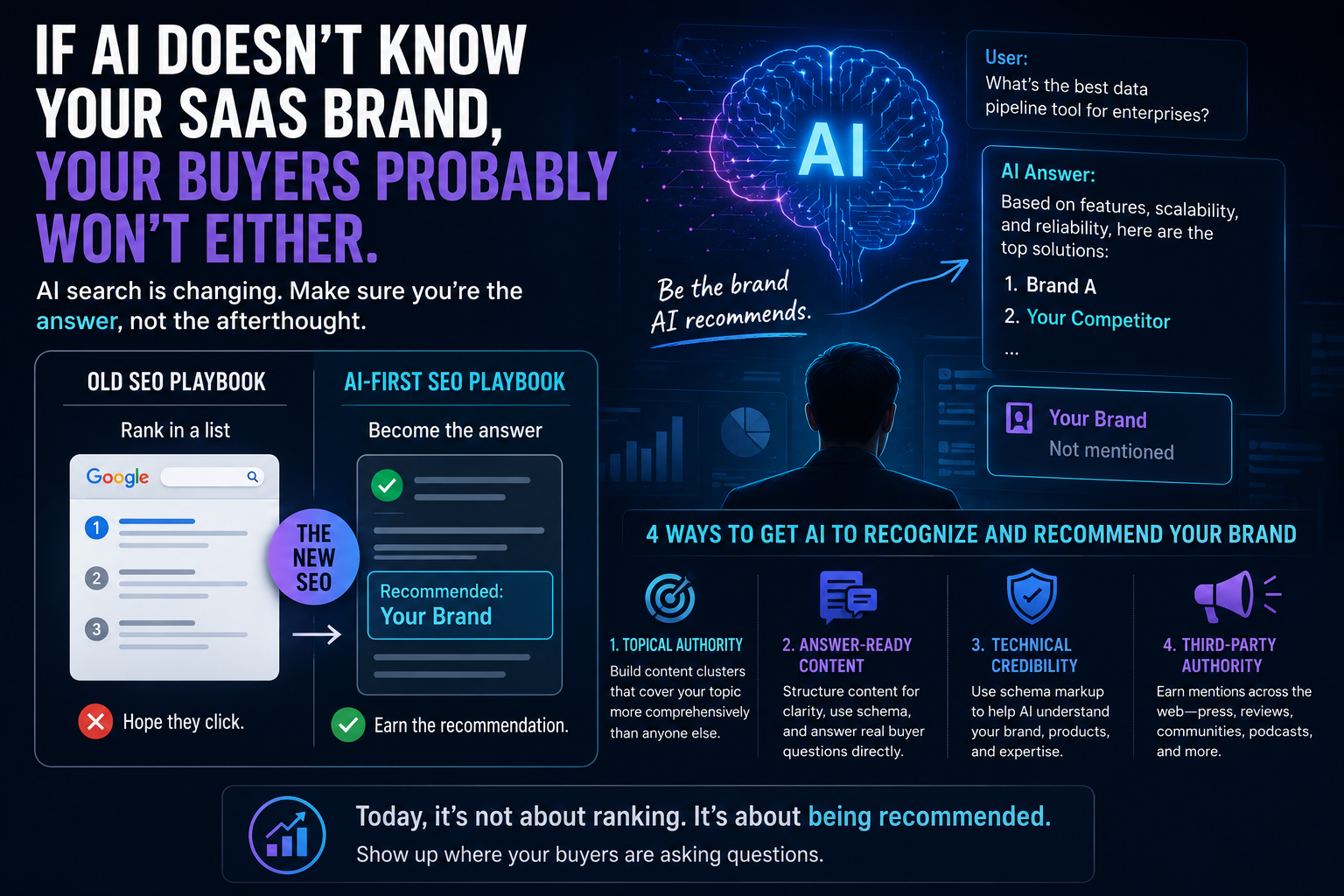
Remember when ranking #1 on Google felt like winning the internet?
Those were simpler times.
Today, your ideal customer isn't just typing keywords into Google. They're asking ChatGPT, Perplexity, Claude, and other AI tools questions like:
"What's the best CRM for fast-growing SaaS companies?"
"Which project management platform scales with enterprise teams?"
The scary part?
AI usually recommends a handful of brands.
If yours isn't one of them...
You don't just rank lower.
You disappear.
Welcome to AI-First SEO
Traditional SEO was about climbing search rankings.
AI search is about becoming the answer.
That means your content can't just be optimized for search engines—it has to be structured so AI systems actually understand, trust, and reference your brand.
Here's how smart B2B SaaS companies are making that happen.
1. Become the Expert on One Topic (Not the Jack of All Trades)
AI loves specialists.
Instead of publishing random blog posts every week, create a content ecosystem around one core topic.
For example:
Pillar Page:
"The Complete Guide to Enterprise Data Pipelines"
Support it with articles covering:
• Security and compliance
• Implementation checklists
• Integration guides
• Vendor comparisons
• Pricing considerations
• Common mistakes
One article earns clicks.
A complete knowledge hub earns trust.
2. Write Content AI Can Actually Quote
Here's an uncomfortable truth.
Some blog posts are so vague even AI skips them.
If your opening paragraph sounds like:
"In today's fast-paced digital landscape..."
Congratulations...
You've written the internet's favorite sleep aid.
Instead:
Answer the question immediately.
Use clear headings.
Add FAQs.
Include step-by-step explanations.
Make every section easy to extract and reference.
If humans can skim it, AI can cite it.
3. Technical SEO Isn't Boring Anymore
Schema markup used to feel like housekeeping.
Now it's more like handing AI a cheat sheet.
Organization schema.
Product schema.
FAQ schema.
How-to schema.
These structured signals help AI understand exactly who you are, what you sell, and why your content deserves attention.
Think of it as introducing yourself instead of hoping AI guesses correctly.
4. Build Authority Beyond Your Own Website
This is where many SaaS companies fall behind.
AI doesn't only learn from your website.
It learns from everywhere.
Industry publications.
Review platforms.
Podcasts.
Case studies.
Communities.
Guest articles.
Analyst reports.
The more credible places your brand appears, the more confident AI becomes in recommending you.
Authority isn't built in one article.
It's built across the web.
The New SEO Question
For years marketers asked:
"Did we rank on Google?"
The better question today is:
"Would AI recommend us without hesitation?"
Because buyers are increasingly letting AI shortlist vendors before they ever visit a website.
If your brand isn't part of that conversation...
Someone else's will be.
The companies investing in AI-first SEO today aren't chasing another marketing trend.
They're making sure they're still visible when search itself changes.
