
From Databases to Dopamine: Why Real-Time Signals Are Redefining B2B Customer Experience
Introduction: When “What Happened?” Isn’t Enough
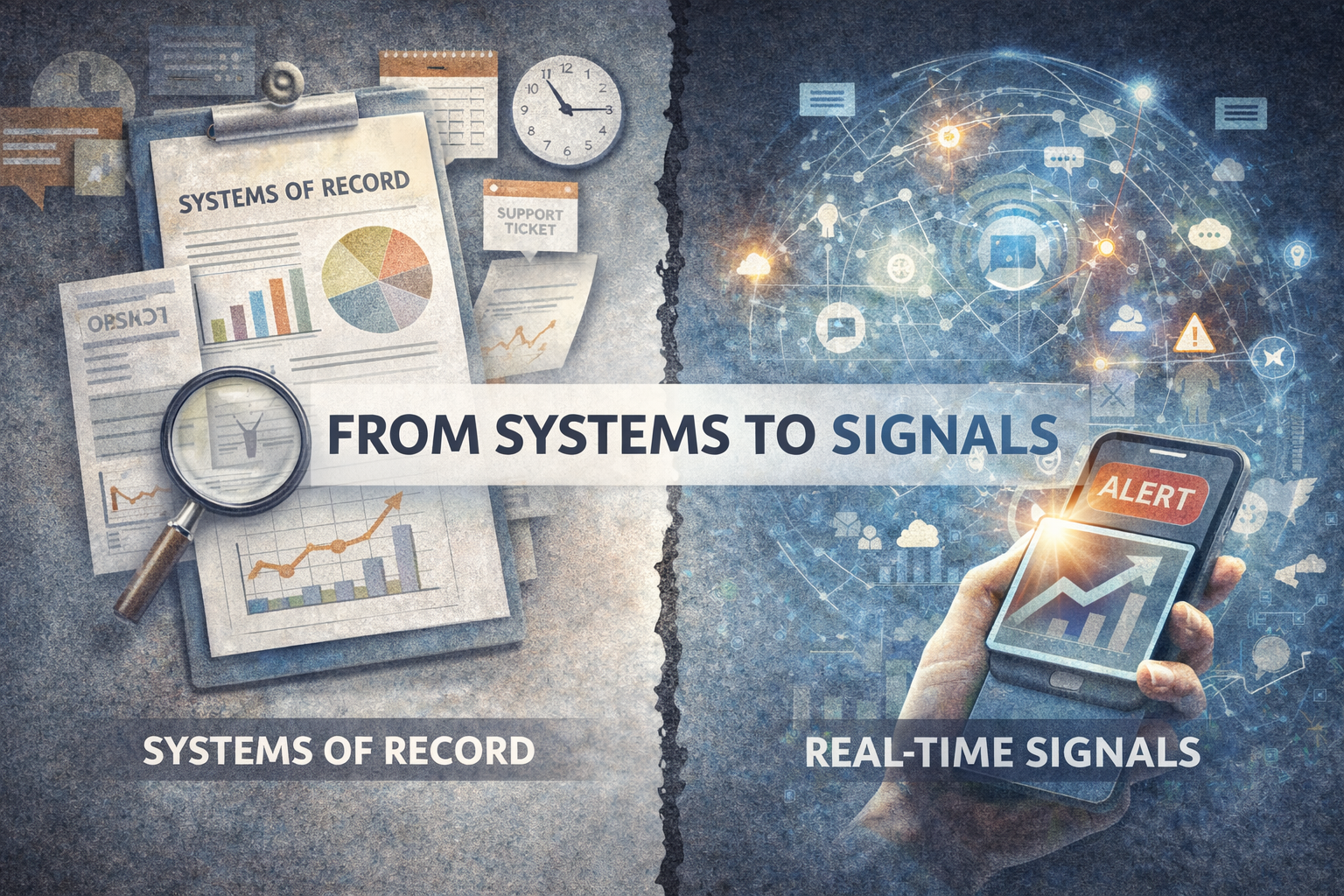
For decades, B2B companies have depended on systems of record—CRMs, ERPs, ticketing tools—to understand their customers. These platforms were great at answering one question: What already happened?
The problem is that modern customers don’t live in the past. They expect immediate answers, proactive service, and experiences that feel tailored—not forensic.
Today’s business operates in real time. And leading B2B organizations are shifting their mindset accordingly: away from static records and toward live customer signals flowing from products, platforms, and interactions. These signals don’t just describe behavior—they tell companies what’s happening right now and what to do next.
The result? A fundamentally different customer experience: faster, smarter, more personal, and far more human.
Below are six ways this shift—from systems to signals—is reshaping B2B CX for good.
1. Why Legacy Systems Are Running Out of Breath
Traditional CX systems were built for reporting, not reacting. They stitch together data after the fact, producing dashboards that explain last quarter’s problems with impressive accuracy—and zero urgency.
Modern CX leaders are asking a different question: What’s happening at this very moment, and how do we respond before it becomes a problem?
To do that, companies are investing in streaming architectures: cloud-native platforms, event-driven data, IoT feeds, and real-time analytics. Instead of waiting for quarterly satisfaction scores, these systems detect early warning signs instantly—usage drops, delays, anomalies—and trigger action in the moment.
In short, systems of record are about hindsight. Signal-driven platforms are about foresight. And in today’s market, foresight wins.
2. Proactive Service: Fixing Problems Before Anyone Complains
One of the biggest CX breakthroughs enabled by real-time data is proactive support. When companies continuously monitor products and services, they can intervene before customers even notice an issue.
Industrial manufacturers, for example, now embed sensors in equipment that stream performance data 24/7. If something looks off, service teams are alerted immediately and can deploy fixes—sometimes remotely—before downtime occurs. Customers arrive at work to discover a problem that used to exist.
The same logic applies to B2B software. Application telemetry now flags errors, security threats, or performance bottlenecks in real time. Instead of waiting for a support ticket, providers reach out with solutions first.
When support shifts from reactive firefighting to quiet prevention, customers don’t just stay satisfied—they start trusting you with their future.
3. Personalization That Actually Feels Personal
B2B buyers don’t suddenly forget how Amazon or Apple works just because they’re at the office. They expect relevance, context, and timing—even in complex enterprise relationships.
Real-time data makes this possible at scale. By analyzing live signals from websites, product usage, support interactions, and account activity, companies can adapt experiences instantly.
If usage spikes in one service, guidance appears immediately. If procurement starts digging into pricing, sales is notified while the interest is still warm. And because B2B decisions involve multiple stakeholders, signal-driven platforms connect the dots across roles—engineering, finance, leadership—to tailor messages for each one.
The result isn’t “creepy personalization.” It’s helpful timing. And that builds confidence faster than any sales deck ever could.
4. End-to-End Visibility: When Everyone Sees the Same Truth
B2B journeys are long, complex, and full of handoffs. Historically, those handoffs lived in different systems, owned by different teams, with very different versions of reality.
Real-time platforms change that by creating a unified, live view of the entire customer journey—from order to delivery to support and beyond.
In supply chains, this means tracking shipments, inventory, and disruptions as they happen, with automatic alerts and suggested responses. In healthcare and pharmaceuticals, it means monitoring sensitive shipments continuously and intervening before failures occur.
Internally, it means sales, service, and operations all see the same data at the same time. No more “let me check with another team.” Just faster decisions and fewer surprises.
Customers notice the difference immediately.
5. Continuous Feedback Beats Quarterly Apologies
Traditional customer feedback models are painfully slow. Surveys arrive weeks later. Reviews happen quarterly. By the time insights surface, the damage is already done.
Real-time feedback flips that script.
In-app prompts, sentiment analysis, and instant alerts now capture customer reactions in the moment. When dissatisfaction appears, teams respond immediately—sometimes within hours.
More importantly, these feedback streams fuel continuous improvement. Patterns emerge faster. Priorities shift sooner. Features get built because customers asked for them yesterday, not last year.
When customers see their input turn into action quickly, loyalty stops being theoretical.
6. Unified Data Creates Real CX Ownership
When data is fragmented, ownership is too. Sales owns sales. Support owns support. CX belongs to… everyone and no one.
Real-time customer intelligence platforms fix that by giving everyone access to the same live customer view. Cross-functional teams monitor customer health together, act together, and solve problems together.
Executives benefit too. Instead of managing CX through monthly reports, leaders see experience metrics evolve daily. If something dips, action happens immediately—not after the next steering committee.
This shared visibility doesn’t just improve decisions. It changes culture. Teams stop asking “Is this my problem?” and start asking “How do we fix this now?”
Conclusion: The Future of B2B CX Is Already Live
B2B companies that have moved from systems to signals are already seeing the payoff: faster resolutions, deeper engagement, and customers who feel genuinely supported.
Those that don’t will increasingly feel slow, distant, and reactive—no matter how good their products are.
Real-time CX isn’t a shiny IT upgrade. It’s becoming the baseline expectation. Customers gravitate toward partners who anticipate needs, respond instantly, and make complexity feel manageable.
The organizations that win will be the ones bold enough to listen to live data, trust it, and act on it—every day.
The future of B2B CX isn’t coming. It’s streaming in right now.
