
B2B Marketing's Favorite Lie: Why Clicks, Downloads, and "Awareness" Won't Pay the Bills
Introduction
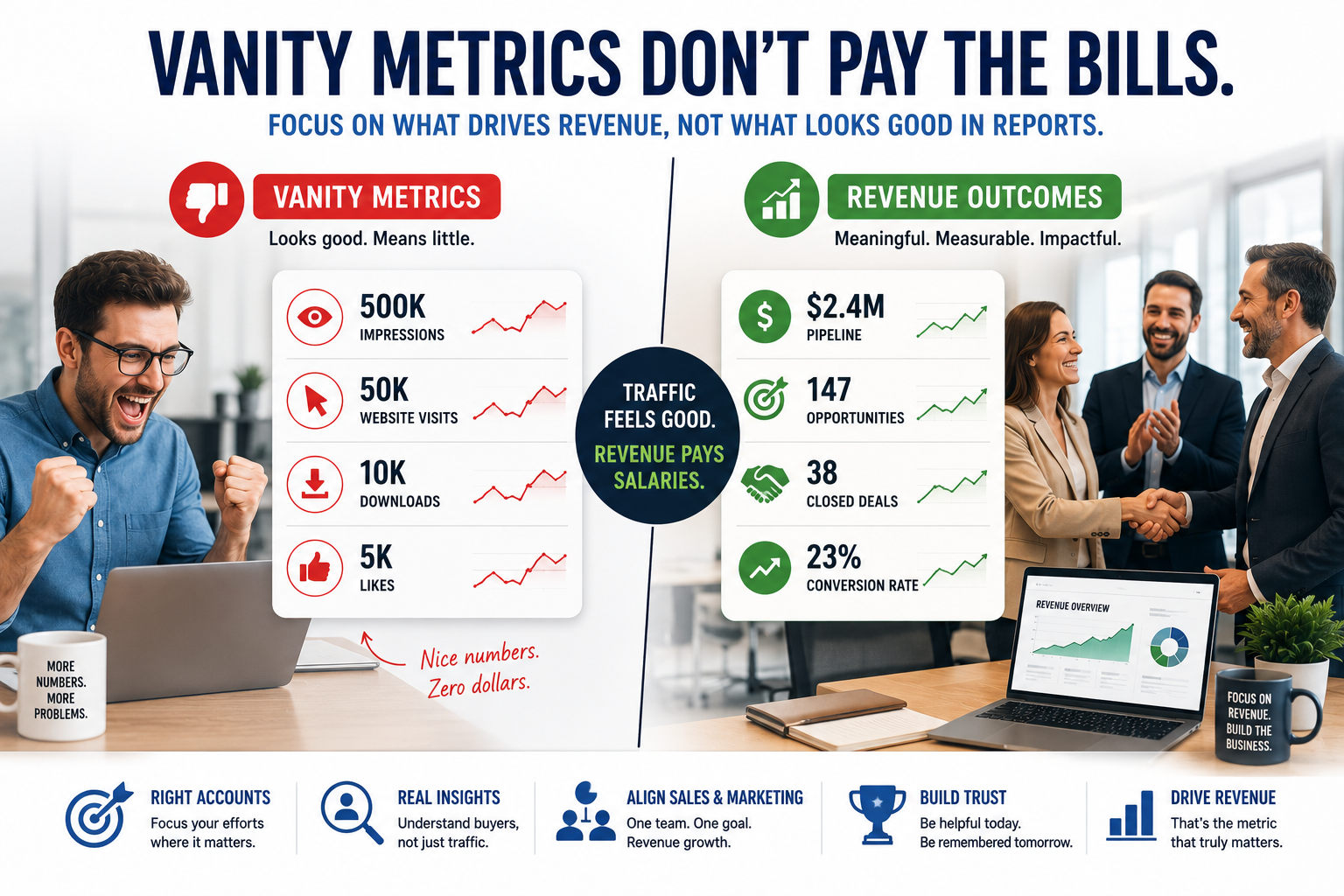
For years, B2B marketers have proudly marched into boardrooms armed with impressive dashboards.
Website traffic? Up.
Content downloads? Up.
Impressions? Through the roof.
Everyone nods. Everyone smiles.
Then someone asks the uncomfortable question:
"How much revenue did that generate?"
Suddenly, the room gets very interested in the coffee.
The truth is that many traditional marketing metrics look fantastic in reports but have little connection to actual business growth. As buying journeys become more complex and budgets face greater scrutiny, B2B marketing is entering a new era—one where activity matters less and outcomes matter more.
The age of vanity metrics is fading. Revenue accountability is taking its place.
B2B Is Not a Popularity Contest
One of the biggest mistakes marketers make is borrowing tactics from consumer marketing.
B2C brands often need massive reach. The more eyeballs, the better.
B2B is different.
Most companies aren't trying to reach millions of people. They're trying to influence a relatively small group of decision-makers inside specific organizations.
The goal isn't attention from everyone.
It's attention from the right people.
That shift changes everything.
Instead of chasing audience growth for its own sake, successful B2B marketers focus on building trust, credibility, and visibility among accounts that actually have the potential to buy.
Because 100 visits from ideal prospects are worth far more than 10,000 visits from people who were never going to become customers anyway.
Pipeline Beats Activity Every Time
Many marketing teams still celebrate metrics simply because they're easy to measure.
Leads.
Downloads.
Page views.
Clicks.
But activity doesn't automatically equal business impact.
A webinar with 500 attendees sounds impressive until you discover none of them fit your ideal customer profile.
The companies generating real growth focus on metrics that connect directly to revenue:
Sourced pipeline
Influenced pipeline
Opportunity creation
Revenue contribution
Customer acquisition
When pipeline becomes the primary scorecard, priorities become clearer.
Suddenly, it becomes much easier to stop investing in activities that generate reports and start investing in activities that generate results.
More Content Isn't a Strategy
For years, marketers followed a simple formula:
Publish more.
Post more.
Write more.
Repeat forever.
The internet responded by producing approximately 47 billion blog posts titled:
"5 Ways to Improve Business Efficiency."
Today's buyers are overwhelmed with content.
The advantage no longer belongs to the company publishing the most content.
It belongs to the company publishing the most relevant content.
The best-performing content:
Solves specific problems
Answers real buyer questions
Provides practical guidance
Addresses genuine business challenges
In B2B marketing, relevance consistently outperforms volume.
Quality wins.
Context wins.
Buyer understanding wins.
Quantity alone doesn't.
Your ICP Is Probably Too Broad
Ask many companies who their ideal customers are and you'll hear something like:
"Enterprise technology companies."
Or:
"Mid-market SaaS businesses."
That's not an ICP.
That's a census category.
Strong targeting requires far greater precision.
Effective ICPs include factors such as:
Company size
Revenue range
Industry niche
Geographic market
Technology stack
Funding stage
Team structure
Business priorities
The more specific your ICP becomes, the more effective your messaging, campaigns, and sales outreach become.
Broad targeting creates generic marketing.
Specific targeting creates pipeline.
Boring Channels Keep Winning
Every year, marketers discover a shiny new growth hack.
Every year, proven channels quietly continue generating revenue.
While experimentation remains important, some channels consistently outperform because they align directly with buyer intent:
Intent-driven search
Coordinated outbound programs
Customer referrals
Strategic partnerships
Co-marketing initiatives
They may not generate headlines.
They may not look exciting in a conference presentation.
But they generate pipeline.
And pipeline tends to be a fairly useful business metric.
Sales and Marketing Should Stop Acting Like Neighbors
Many companies claim sales and marketing are aligned.
Then they operate like two departments living in adjacent apartments who occasionally wave at each other in the hallway.
Real alignment looks different.
High-performing organizations create continuous feedback loops:
Marketing joins sales conversations
Sales shares objections and market insights
Marketing creates assets addressing those objections
Sales actively uses those assets throughout the buying process
When both teams work toward shared revenue goals, buyers experience a more consistent and persuasive journey.
Everyone wins.
Especially the revenue team.
Brand Is Not a Logo
Performance marketing often receives most of the attention because results appear quickly.
Brand building takes longer.
But its impact compounds.
Strong brands create:
Familiarity
Trust
Credibility
Market recognition
Many buying decisions begin long before a prospect enters a sales process.
When purchase intent finally appears, familiar brands often have a significant advantage.
A logo alone doesn't create that advantage.
Consistent market presence does.
Attribution Doesn't Tell the Whole Story
Every marketer wants perfect attribution.
Every buyer refuses to cooperate.
Modern B2B purchases involve:
Content consumption
Referrals
Social engagement
Events
Peer recommendations
Sales conversations
Independent research
Often over several months.
Sometimes over several quarters.
Attribution models remain useful, but they rarely capture the full complexity of how buying decisions happen.
Growth is usually the result of cumulative trust rather than a single touchpoint.
The companies that consistently show up, educate, and remain relevant are often the ones buyers remember when it's finally time to choose a vendor.
The Future Belongs to Focus
The next generation of B2B marketing won't be defined by volume.
It will be defined by focus.
Focus on:
The right accounts
Revenue-generating metrics
Buyer needs
Sales alignment
Long-term trust
Sustainable growth rarely comes from viral campaigns or marketing shortcuts.
More often, it comes from doing the fundamentals exceptionally well over time.
The companies that stop optimizing for activity and start optimizing for outcomes will be the ones that win.
Because at the end of the day, impressions don't close deals.
Revenue does.
